The Strighel of Caelthir
The Strighel are the people of Caelthir, native to the high canopy of Thiravel Wood. Their name is derived from an old root meaning owl, a reference not only to their owl-like features but to the qualities they value most: watchfulness, patience, and the careful holding of knowledge. Among themselves, the name carries no symbolism — it is simply who they are — but outsiders have long associated the Strighel with the quiet vigilance of owls in the forest.
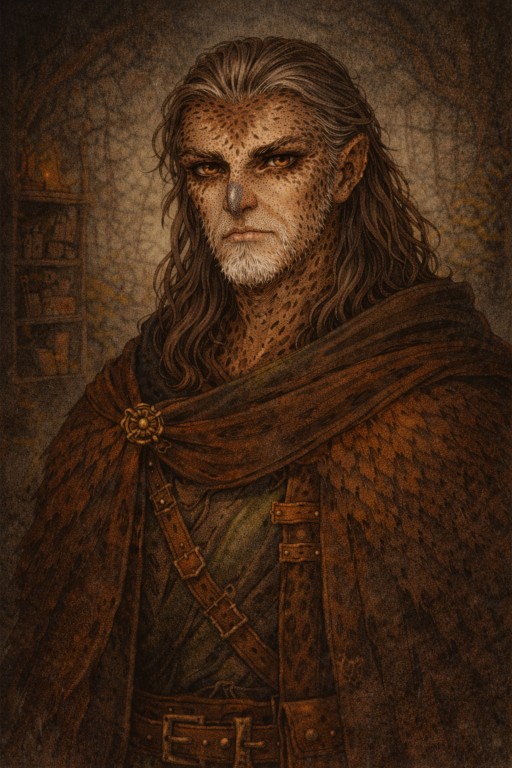
To those beyond Thiravel, the Strighel are often called the Watchers of the High Boughs, a title born from distant observation and rumor rather than understanding. Travelers speak of eyes glimpsed in lanternlight, of figures who seem to notice without intervening, and of a people who see events unfold without haste or judgment. The Strighel do not deny this reputation, but neither do they encourage it; watching, to them, is not power, but responsibility.
Strighel culture favors stillness over display and memory over record. Knowledge is gathered slowly, through long observation and shared recollection, and passed on through teaching rather than proclamation. They do not seek to shape the world beyond Thiravel Wood, believing instead that understanding comes from seeing how things change when left to endure.
Saying
“The forest speaks longest to those who do not interrupt it.” - Strighel saying
Prompt
Style Wrapper:
Rendered in a hand-drawn, symbolic fantasy style with visible linework and dry-brush or ink-wash textures. The image prioritizes interpretation over realism: forms are simplified, edges are softly broken, and surface detail is suggested rather than fully resolved.
Faces are emotionally present and readable, with restrained expression and direct or near-direct gaze. Facial proportions remain natural and adult, avoiding exaggeration or stylized animation traits.
Shading is tonal and painterly rather than cinematic. Lighting is soft and diffuse, but colors retain body and pigment rather than collapsing into greys or flat browns. No dramatic highlights, rim lighting, or photographic depth of field.
Color palette favors earth-rich, mineral, and botanical pigments with controlled saturation — warm umbers, tawny browns, bone tones, lichen greens, muted rusts, charcoal greys, and aged bronze. Colors remain distinct and readable when scaled down for 2D game portraits and speech bubbles.
Clothing and materials appear functional and lived-in, with texture implied through mark-making rather than sharp realism. No heroic posing, ornamental spectacle, or theatrical gestures.
Backgrounds are impressionistic and slightly darker or less saturated than the character, providing context without competing for attention.
The overall impression should feel adult, wise, and grounded — subtly otherworldly without spectacle — and visually clear within a stylized fantasy game interface.
Main Prompt:
An older Strighel individual from Caelthir, shown from mid-torso upward, suitable for use as an elder, scholar, or authority figure in a fantasy game. He has a fully human facial structure — skull, jaw, mouth, and proportions — marked subtly by owl-like traits rather than overt transformation.
His eyes are forward-facing and steady, conveying patience, judgment, and long memory rather than aggression. The irises are deep amber or burnished gold with subtle internal variation, catching light enough to remain readable when scaled down.
Owl influence appears through fine facial texture and feathering rather than anatomy. Short, close feathers blend into the skin across the brow, temples, cheeks, and upper neck. Feather tones range through warm umbers, tawny browns, muted golds, and bone-white highlights, with slight variation to avoid flatness.
Hair is human, long, and worn loose, with a natural wave. It is thick but weathered, showing ash-brown and iron-grey strands rather than uniform greyness, suggesting age through use rather than decline.
His expression is reserved and stern but not hostile — emotionally controlled, attentive, and grounded. He appears to be listening or weighing words rather than asserting dominance.
Clothing is layered, functional, and worn, appropriate to a woodland or scholarly role. Fabrics are heavy and practical, rendered in deep bark browns, dark lichen greens, muted rust, and charcoal-grey tones, chosen for richness rather than dullness. Leather straps and fastenings show warm, oiled brown and bronze notes, providing subtle contrast.
A simple brooch or clasp holds the cloak, rendered in aged metal tones — brushed bronze or dull gold rather than steel — understated but visually anchoring.
The background is lightly suggested only — hints of stone, shelves, or forest-shadowed interior forms — kept darker and less saturated than the figure so the face and upper torso remain clearly legible.