The Ashkarians
(known in Wendmor as the 'Emberborn')
Description
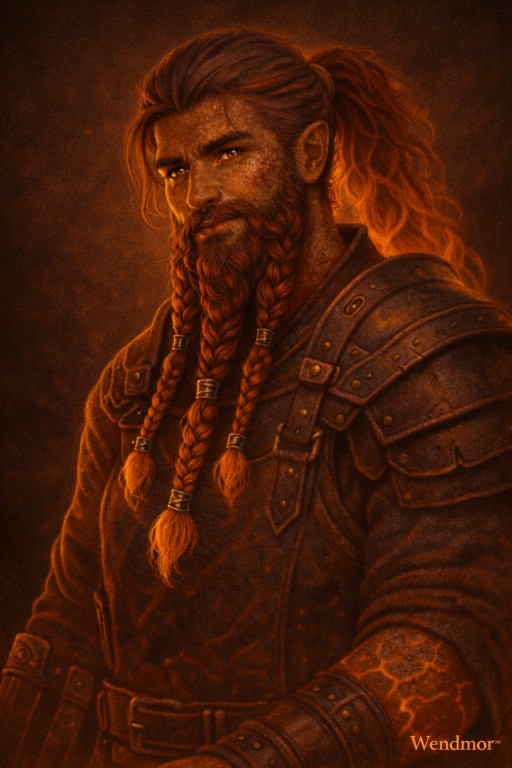
The Ashkarians are a people shaped by heat, pressure, and time. They dwell within the volcanic caldera of Mount Kareth, in the settlement of Ashkar Deep, where obsidian cliffs, lava channels, and mineral-rich stone form both their environment and their craft.
To outsiders, the caldera is a place of danger and destruction. To the Ashkarians, it is a system — demanding, unforgiving, but honest.
Ashkarians have evolved over generations to endure extreme heat and mineral exposure. Their bodies tolerate temperatures that would incapacitate others, and their senses are finely attuned to changes in stone, pressure, and thermal flow. This adaptation is not understood outside Ashkar Deep and is often regarded with suspicion.
Physically, Ashkarians are marked by soot-darkened skin, ember-tinted hair, and dark eyes that catch light like smoldering coals. These traits are not ceremonial or symbolic — they are the result of long exposure to the caldera’s conditions.
Culturally, they are patient, deliberate, and reserved. Ashkarians value endurance over speed, precision over force, and understanding over domination.
Craft and Purpose
Ashkar Deep exists for one reason: extraction and forging at the source.
Volcanic pressure within Mount Kareth has exposed rare mineral veins deep inside the caldera — ores, gems, and compounds altered by prolonged heat and geological stress. Ashkarians mine these seams with care, tunneling only into stable zones and abandoning passages long before collapse or thermal shift.
Unlike other peoples of Wendmor, Ashkarians do not remove raw materials from their environment. Instead, they forge directly within the caldera, using lava-fed furnaces, heat channels, and stone-forged systems refined over centuries.
The materials produced in Ashkar Deep are renowned for their density, durability, and resilience. Many are impossible to replicate elsewhere.
Relationship to the Outside World
Ashkarians trade selectively.
Other races seek them out for rare metals, heat-touched gems, and forged artifacts capable of withstanding extremes. These goods circulate widely through Wendmor, but the Ashkarians themselves rarely do.
Outsiders are permitted into Ashkar Deep only briefly, and never without guidance. Few are comfortable remaining near the lava for long, and fewer still understand how the Ashkarians endure it. This lack of understanding has bred both awe and distrust.
To many in Wendmor, the Emberborn are unsettling — calm where others would panic, silent where others would explain. Ashkarians do little to correct these perceptions.
World View
Ashkarians do not worship fire or the mountain. They do not believe Mount Kareth to be benevolent or cruel. It simply is.
Their philosophy is grounded in acceptance of limits: knowing when stone will hold, when heat will rise, and when a material must be left alone. This outlook extends beyond craft into daily life, shaping their relationships, their restraint, and their reluctance to interfere in the affairs of others.
Change, when it comes, is slow and deliberate.
Common Saying
“Don’t force materials. Wait until they agree.”
Prompt
Style: Semi-realistic fantasy character illustration in a grounded, painterly style. Naturalistic lighting, muted cold tones, visible brush texture. No cartoon or graphic-novel style.
A humanoid figure adapted to life on ice. The body is lean and balanced, with long limbs suited to fluid motion rather than strength. The posture suggests movement even at rest — weight shifted, feet angled, arms relaxed but ready.
The face is human-adjacent, calm and attentive, with features shaped more by wind and cold than hardship. Hair is kept short or tightly bound. Skin shows subtle signs of exposure — pale tones, wind-reddened edges, no heavy scarring.
Clothing is minimal and functional: layered wraps and fitted garments that allow full range of motion, leaving limbs partially exposed. Materials are light, flexible, and textured, designed to move with the body rather than against it.
The setting is an open ice field beneath shifting sky — snow in motion, wind visible through drifting ice particles. No structures, no landmarks. The figure is part of the surface rather than imposed upon it.
Lighting is cold and directional, emphasizing form, balance, and motion rather than drama.
Overall impression: a people who do not conquer their environment, but become legible within it.