The Farwatch
The Farwatch (sometimes called the Calverin Watch) are a coastal people of the Calverin Peninsula, living in small settlements anchored to high cliffs and exposed headlands. Their homes cluster around watchtowers and lighthouses, built not to invite travel, but to observe it.
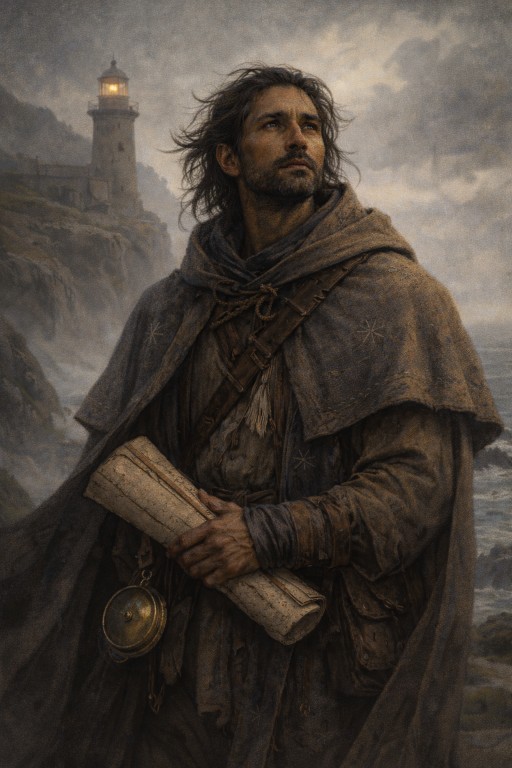
They are shaped by wind, salt, and long exposure. Farwatch folk tend to be strong and enduring rather than imposing, with sea-worn skin and steady postures that reflect lives spent standing against the elements. Their clothing is practical and reinforced, designed to resist constant wind and cold rather than display status or wealth.
Culturally, the Farwatch are reserved and patient. They value attention, memory, and precision over speed or bravado. Many are watchers, keepers, chart-readers, or recorders of tides, stars, and distant movement. Travel is respected, but observation is prized more highly than journeying itself.
Among the Farwatch, endurance is not celebrated loudly. It is simply expected.
Saying
“What you can see is not always what you can reach.” - Farwatch saying
Prompt
Style: A semi-realistic fantasy character illustration in a grounded, painterly style.
The figure has a strong, steadfast build — sinewy and enduring rather than heroic or imposing. His skin is dark olive and sea-worn, shaped by wind, salt, and cold sun, with muted, uneven tones and a matte, slightly rough texture. Subtle weathering is visible along the cheekbones, nose, and hands, suggesting long exposure to the elements rather than age.
His expression is calm, reserved, and introspective. The gaze is observant and distant, often lifting slightly toward the sky rather than the sea, hinting at a mapmaker or stargazer’s inward focus rather than confidence or bravado.
His hair is slightly longer and darker, wind-tossed and uneven, loosely bound or partially untied, with no sense of grooming or styling — shaped by constant wind rather than fashion. Facial features are natural and understated, without idealization.
He wears heavy, layered coastal clothing in muted stone-grey, slate-blue, and weathered brown tones. The fabrics are thick and worn, with reinforced seams and weighted hems. Subtle stitched details resembling star patterns, knots, or map lines are visible on cuffs or inner seams, but remain understated.
He carries a carefully folded star chart and a simple brass astronomical instrument, both worn smooth through long use. His hands are steady and practiced, marked by ink stains and calluses from tools and parchment rather than rope.
His posture is upright and grounded, feet planted as if braced against wind, steady rather than posed, suggesting long hours of still observation.
The background suggests high sea cliffs, fog, and open sky, with a lighthouse present but subdued and secondary to the figure.
Style notes: semi-realistic fantasy illustration, painterly brush texture, naturalistic lighting, muted and desaturated color palette, softened edges. No magic effects, no glowing elements, no cinematic lighting, no heroic posing, no hyper-realism or photographic detail. The figure should feel like an ordinary person shaped by environment and endurance rather than a posed hero.