The Lethari
The Lethari are a people of the Eldermires whose presence does not assert itself. They do not hide, conceal, or withdraw. They walk openly through forest and water, speak among themselves, and go about their lives without caution. Yet to non-Lethari, they are rarely noticed at all.
Those who pass through the Eldermires often later realize they never truly looked at the land while moving through it. The Lethari were there the entire time.
Presence and Perception
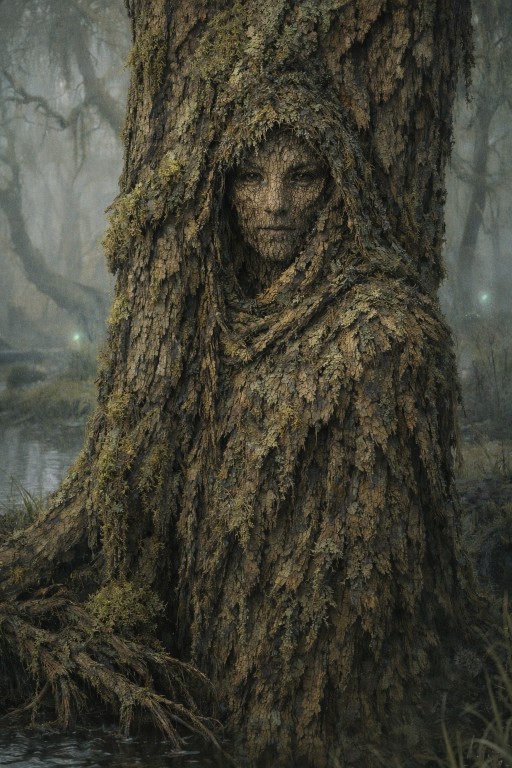
The Lethari are not invisible. They are not silent. Nothing about them is disguised. Instead, attention simply fails to settle on them. Eyes pass over their forms. Ears register sound without assigning it source. Paths bend the gaze elsewhere.
To the Lethari, this is not a skill or practice. It is simply how they exist.
They do not stalk, observe, or wait in ambush. They are seen by one another constantly. Only outsiders experience the absence.
Contact
Encounters with the Lethari do not occur through discovery.
Contact begins when a Lethari addresses someone directly. A voice is heard where no one was noticed. A figure resolves where there had been only bark, mist, or movement. In that moment, perception aligns, and the Lethari becomes unmistakably present.
Once contact is established, it does not feel threatening or uncanny. The Lethari are widely described as friendly, hospitable, and curious. They offer guidance, conversation, and assistance freely, as if the meeting had always been expected.
When the interaction ends, attention drifts again. Those who part ways often find the details difficult to recall clearly, though the sense of being welcomed remains vivid.
Social Nature
The Lethari place great value on hospitality. Visitors who come to them—rather than attempting to force understanding—are treated with warmth and patience.
They ask few questions and offer few explanations. From their perspective, nothing unusual has occurred. Outsiders often feel as though they have stepped briefly into a different rhythm of attention, then returned to their own.
What the Eldermires Become
Because of the Lethari, the Eldermires are not a place of danger, but of misalignment. Nothing here conceals itself. Nothing reveals itself on demand.
Travelers who move quickly or with fixed intent may pass through without ever knowing the Lethari exist. Those who slow, pause, or wander without aim sometimes find themselves spoken to.
In the Eldermires, being seen is not earned through effort. It happens when attention finally rests where it already was.
Open Questions
These remain deliberately unresolved:
- Do the Lethari perceive non-Lethari the same way?
- Can alignment occur accidentally, or only through stillness?
- What happens when a Lethari leaves the Eldermires?
- How do they remember events in a world that forgets them so easily?
Prompt
Style: Semi-realistic fantasy illustration, grounded and naturalistic, with restrained fantasy elements and no overt magic.
A misty lowland forest bog with leaning, stunted trees growing from peat-dark water. Bark is dark, rough, and layered with moss and lichen. Roots spread outward into shallow pools. Low fog hangs between trunks, muting depth and breaking clear outlines.
In the foreground, standing directly in front of a tree, is a single Lethari. At first glance, the scene appears empty.
The Lethari is not hiding, but their body visually merges with the tree behind them. Their cloak is woven from organic fibers and patterned like bark grain and lichen growth, with irregular edges that dissolve into shadow and moss. The cloak aligns closely with the vertical textures of the trunk, making the figure difficult to separate from the forest.
Their face is subtly non-human and bark-like: flatter planes, weathered texture, muted earthy tones, faint wood-grain cracking beneath smooth but matte skin. The face lacks human softness or pink tones. Eyes are calm and expressive, set deep in shadow, with faint, natural patterning in the iris — warm and attentive rather than uncanny.
Only after careful viewing does the face resolve clearly. The rest of the body remains partially lost in bark texture, fog, and shadow, like a moth resting against a tree.
Sparse, dim blue-green will-o’-the-wisp lights appear far in the background and do not illuminate the figure.
Lighting is diffuse and grey-blue, with muted greens, browns, and black water. No sharp highlights, no strong contrast, no creatures, no visible magic.
The mood is quiet and attentive — a place where perception settles slowly.