The Velari
The Velari are the people of the Ithral, a culture shaped not by survival, but by a lifelong pursuit of grace. Where others see ice as absence or limit, the Velari see a surface uniquely suited to motion, balance, and expression. Their way of life is not built around endurance, but around the refinement of movement in the harshest conditions Wendmor offers.
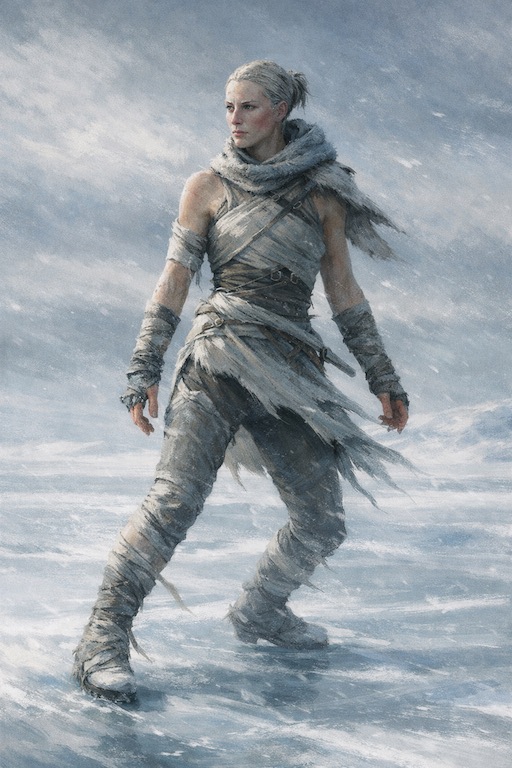
The Velari do not seek to master the ice. They move with it. Ice is treated as a partner rather than a resource — something to be read, listened to, and answered through motion. Standing still for too long is considered a failure of attention, not a sign of rest.
From an early age, Velari children are taught to skate before they are taught to travel. Long, narrow blades are fitted gradually as bodies grow, adapted for uneven ice, pressure cracks, and wind-scoured surfaces. Movement is fast, fluid, and graceful. Speed is not valued for its own sake; clarity is.
The Mother’s Dance
At the age of nine, every Velari performs their mother’s dance.
The entire settlement gathers. There is no applause, no criticism, and no record of success or failure. The performance ends in shared celebration — not of skill, but of incompletion. The dance is understood to be unfinished, both by the dancer and by tradition.
Over the next seven years, the Velari is free to return to the dance in their own way. Some pursue exact replication, refining each motion toward fidelity. Others alter the form, responding to changes in body, temperament, or environment. There are no rules governing this process.
At sixteen, the dance is performed again. What is shown is accepted without comment. From that moment on, the dance belongs to the dancer — or is left behind entirely. Many Velari never perform it again. Others return to it decades later. All paths are considered complete.
Thir
The Velari maintain communal balance through a team game known as Thir.
Thir is played on open ice using long-bladed skates and a weighted disc that moves unpredictably across fractured surfaces. There are goals, but no scores, no winners, and no fixed match length. Play continues until the conditions themselves bring it to an end.
What matters in Thir is not whether a goal is achieved, but how it is achieved. Wind, snow, darkness, moonlight, and surface instability are not considered obstacles; they are part of the play. A single moment of perfect alignment — a pass made blind through snow, a turn held across a breaking pressure line — may be remembered for generations.
After a game, Velari do not recount outcomes. They relive moments.
Body, Cold, and Exposure
The Velari are physiologically and culturally adapted to cold. They wear thin clothing that allows for expression of movement. They consider their bodies as the primary instrument, and sensation is essential to precision.
Harsh conditions are not merely tolerated — they are sought. Snowfall, reduced visibility, and extreme wind are considered ideal circumstances for testing clarity of motion. A dance performed in calm weather is respected. A dance performed in a storm is remembered.
Social Structure
Velari society is warm, expressive, and communal, but not indulgent. Praise and criticism are both considered distractions from attention. Individuals are expected to find their own measure through practice rather than approval.
There are no formal leaders. Influence accrues to those whose movement is trusted — not because it is flawless, but because it remains coherent when conditions worsen.
The Velari do not expand. Their numbers are regulated by custom and choice. They believe growth without refinement leads only to noise.
Relationship to Outsiders
Outsiders are often struck by the beauty of Velari movement, but rarely by its meaning. Most can see that a dance or a game of Thir was remarkable, yet cannot understand how the Velari know when it was complete — or why no explanation follows.
The Velari do not teach through correction. Imperfection is recognized internally, without guidance or critique, as something to be returned to rather than erased. To outsiders, this appears evasive or indulgent; to the Velari, it is the only way attention can remain intact.
Very few Velari feel pity toward other peoples, but all understand themselves to be fortunate. They believe their way of life grants access to a clarity others may never experience, not through intelligence or effort, but through circumstance. This quiet sense of blessing is often mistaken for arrogance.
As a result, the Velari are widely admired and rarely embraced. Their confidence in unspoken understanding unsettles those who rely on instruction, rules, or visible judgment. To many, the Velari appear graceful but distant — present, yet slightly elsewhere.
Saying
“Motion reveals what stillness hides.”
Velari saying
Prompt
Style: Semi-realistic fantasy character illustration in a grounded, painterly style. Naturalistic lighting, muted cold tones, visible brush texture. No cartoon or graphic-novel style.
A humanoid figure adapted to life on ice. The body is lean and balanced, with long limbs suited to fluid motion rather than strength. The posture suggests movement even at rest — weight shifted, feet angled, arms relaxed but ready.
The face is human-adjacent, calm and attentive, with features shaped more by wind and cold than hardship. Hair is kept short or tightly bound. Skin shows subtle signs of exposure — pale tones, wind-reddened edges, no heavy scarring.
Clothing is minimal and functional: layered wraps and fitted garments that allow full range of motion, leaving limbs partially exposed. Materials are light, flexible, and textured, designed to move with the body rather than against it.
The setting is an open ice field beneath shifting sky — snow in motion, wind visible through drifting ice particles. No structures, no landmarks. The figure is part of the surface rather than imposed upon it.
Lighting is cold and directional, emphasizing form, balance, and motion rather than drama.
Overall impression: a people who do not conquer their environment, but become legible within it.