The Belthari of Belthara
The Belthari are the people of Belthara, a broad riverland formed by accumulation rather than motion. Over long periods, fine mineral silt and volcanic deposits carried downstream from Mount Kareth have settled across its plains, building deep, dark soils that hold water and nutrients with unusual reliability. The Belthari have shaped their lives around this dependability, becoming the primary agricultural culture of Wendmor.
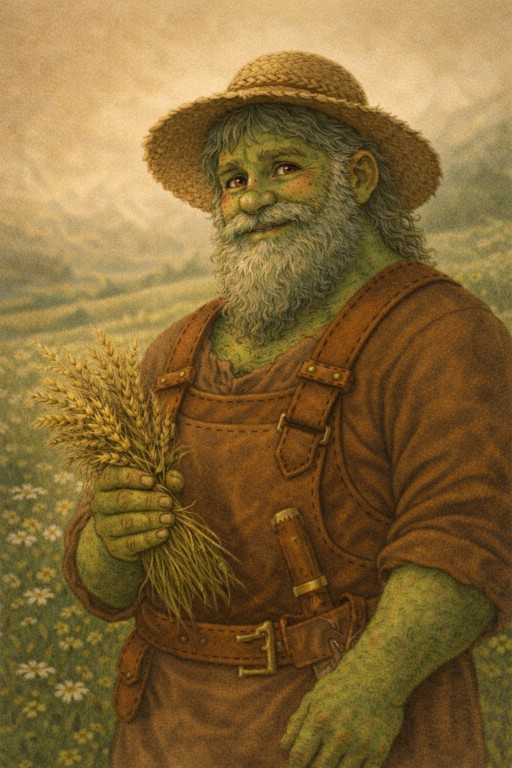
Belthari society is grounded in continuity. Fields are worked across generations, not claimed or abandoned lightly. Boundaries are marked less by ownership than by responsibility, and land is valued for what it can sustain over time rather than what it can yield in a single season. Strength among the Belthari is measured in endurance, coordination, and care.
Physically, the Belthari tend toward broader builds and greater mass than many neighboring peoples. They are not swift, but they are resilient. Their bodies are shaped by labor rather than conflict: carrying, lifting, digging, repairing. Sun exposure marks them clearly, and their skin often bears mineral hues drawn from soil, water, and long hours in open fields.
Farming in Belthara is extensive and deliberate. Wide grain fields, orchards, and managed waterways dominate the landscape, supported by mills, granaries, and storage yards built for scale and longevity. Crop planning favors reliability over novelty, with rotation, soil treatment, and water control guided by long-established practice. Innovation is adopted cautiously and collectively, only when it strengthens stability rather than risk.
Much of Belthara’s fertility depends on materials that cannot be produced on the surface alone. Mineral-rich ash, crushed volcanic stone, and potash-like salts extracted from the cave systems beneath Mount Kareth are brought up by the Kikela in steady, regulated exchanges. These materials enrich the soil, restore exhausted fields, and allow agriculture at a scale that would otherwise be impossible. The Belthari have neither the skill nor the inclination to mine such environments themselves.
In return, the Belthari supply grain, fruit, and preserved foodstuffs that cannot be grown underground. This exchange is not opportunistic trade but a structured interdependence, reinforced through custom and shared history. In times of poor harvest, the Kikela supply the Belthari without charge. In times of underground collapse or volcanic unrest, Belthari stores and labor are redirected without negotiation.
The relationship between the two peoples was not always cooperative. In the early ages of Wendmor, during the period remembered as the Great Displacement, the Belthari settled lands once inhabited by the Kikela. Conflicts over land and resources followed, remembered today through fragmented folklore and place-names whose origins are uncertain. Over time, competition gave way to separation, and separation to specialization. What began as displacement became dependence.
Today, neither people thrives without the other. The Belthari understand that their abundance is rooted in the mountain’s depths. The Kikela understand that withdrawal without support only leads to famine. Trust between them is both practical and sentimental, built on repetition, responsibility and a rich cultural exchange.
Folklore
Belthari folklore is almost entirely agricultural, and for that reason is often dismissed by other peoples of Wendmor as naïve or provincial. While other cultures tell stories of kings, wars, and divine intervention, Belthari tales concern fields, tools, weather, and stubborn acts of cultivation carried out over long periods of time.
Their legendary figures are rarely conquerors. They are remembered instead for endurance and ingenuity: the farmer said to have grown a zucchini so large it fed an entire village through a lean season, or the ancestor who climbed Mount Elbrin and stole the secret of crafting watering cans from the stone-bound beings believed to dwell there. These stories are told without irony within Belthara, and with considerable irony elsewhere.
Many Belthari treat such tales as exaggeration rather than falsehood. The details may be embellished, but the underlying belief remains that patience, repetition, and care can produce results others would consider impossible.
Among the more disputed elements of Belthari folklore are the tales of Mirror Crops. These stories describe plants that behave almost like their ordinary counterparts, but not quite: beans that cause uncontrollable flatulence when eaten, onions that reduce even the most stoic to tears, pumpkins said to grow faces and glow faintly from within, or herbs whose flavor shifts with the mood of the cook.
Most Belthari repeat these stories with amusement. Few claim to have seen such crops themselves, and fewer still admit to believing they could be grown deliberately. Outside Belthara, the tales are usually cited as proof of Belthari credulity.
Even so, the stories persist — passed down alongside planting calendars and soil advice — treated neither as doctrine nor as nonsense, but as part of the long conversation between land and those who work it.
Saying
“What feeds the land feeds us all.”
Belthari saying
Prompt
Belthari Elder – Female
Semi-realistic fantasy character illustration rendered in a hand-drawn, symbolic style with visible linework and subtle ink-wash or dry-brush textures. Interpretation is prioritized over realism: forms are simplified, edges softly broken, and surface detail is suggested rather than fully resolved.
An older female member of the Belthari, a near-human agricultural people shaped by soil, moisture, and long seasonal labor. Her appearance must be clearly female within Belthari biology and must not resemble a male Belthari with altered hair, posture, or clothing.
Body & Posture: Anatomy follows Belthari racial structure, with visible sexual dimorphism. The neck is shortened, with the head seated into the shoulders. Her build is compact and grounded, with a low center of gravity. Compared to male Belthari, upper-body mass is distributed more evenly, with less emphasis on shoulder bulk and more weight carried through the torso and hips. Posture is stable and settled, shaped by decades of repetitive, close-to-the-ground agricultural work.
Face: Facial structure is broad but distinctly female, with differences that are structural rather than decorative:
The brow ridge is present but lower and smoother than in male Belthari, without heavy overhang.
The forehead is slightly taller and more continuous, reducing aggressive shadowing.
The jaw is wide but shorter and more rounded, with less angular mass at the corners.
Cheekbones are wider and more forward-set, creating a fuller mid-face without youthfulness.
The mouth is slightly wider, with lips thin from age but not tightly compressed.
Lines around the eyes and mouth reflect long familiarity with sun, soil, and seasonal cycles — authority through continuity rather than severity.
Eyes: Eyes are dark brown to deep umber, earth-rich rather than reflective. They are slightly hooded but set marginally wider and less deeply recessed than male Belthari eyes, reducing confrontational cues. The gaze is assessing and practical, suggesting judgment shaped by experience rather than emotion.
Nose: The nose is broad and low-bridged, with a widened base and blunt tip shaped by age and outdoor labor. It is less projecting and less dominant than in male Belthari, with softer transitions rather than sharp profile breaks. Avoid symmetrical or human-idealized forms.
Skin: Skin coloration is strongly green-dominant, matching the same saturation range as male Belthari such as Alaric. Green is not muted or olive-only.
Color variation includes:
moss green lichen green leaf-dark green warm soil undertones beneath the surface
The skin reads clearly and richly green at first glance, with mottling, staining, and age variation layered on top rather than replacing the base tone.
Ears: Ears follow Belthari racial structure: thicker, softly rounded, heavier at the base, and subtly asymmetrical. They are slightly smaller and less protruding than male Belthari ears, contributing to a calmer facial silhouette.
Hair: Hair is green-grey to moss-green, coarse and biologically grown rather than styled. It is worn pulled back or loosely braided purely for function, with uneven tension and stray strands. Color shows variation through deeper green roots and lighter, weathered lengths rather than uniform greying.
Clothing: Clothing consists of simple, layered agricultural garments. Materials resemble worn leather and coarse cloth, rendered in rich bark browns, oiled leather tones, muted rusts, and soil-dark greens, chosen for depth rather than dullness. Garments are repaired, creased, and shaped by long use. No ornamentation.
Rendering & Lighting: Shading is tonal and painterly rather than cinematic. Lighting is soft and diffuse, but color saturation is preserved, especially in skin and hair. Colors retain pigment and weight and remain readable when scaled down for a 2D fantasy game interface. No rim lighting, dramatic highlights, or photographic depth of field.
Background: The background is lightly suggested only — hints of fields, grain stores, or earth-toned interior forms — kept darker or less saturated than the figure so she remains the clear focal point.
Overall Impression: The overall impression is one of endurance, continuity, and grounded authority — a woman whose judgment is trusted because she has lived the cycles repeatedly. She is unmistakably Belthari, unmistakably female, richly green, emotionally present without dramatization, and fully compatible with a stylized fantasy game world.