The Kaelun
The Kaelun are a wandering people of the south-eastern Ithral Plain, known for their caution, memory-keeping, and uneasy relationship with the wild. Their culture is built around movement and restraint. Camps shift with the seasons along established routes, never staying long enough for animals to grow accustomed to their presence or for the land to be exhausted. To the Kaelun, remaining in one place for too long invites carelessness — and carelessness invites disaster.
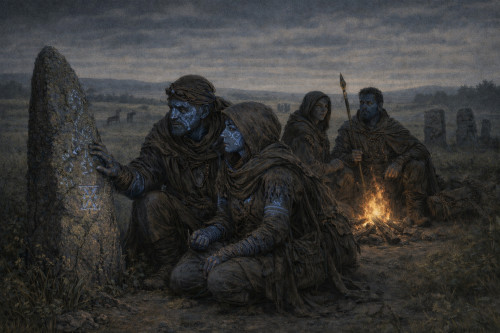
Physically, the Kaelun are recognisably human, but marked by their land and history. Their skin ranges from deep umber to blue-grey, often carrying a slate, ash, or dust-toned cast that darkens with sun and wind exposure on the open plain. This colouring is natural, not magical, and is often described by outsiders as “storm-dark” or “stone-touched.”
Kaelun bodies tend toward lean, compact builds shaped by distance walking, long watches, and constant alertness rather than heavy labour or warfare. Muscle is wiry rather than bulky. Their movements are economical and deliberate; they waste little energy on display. From childhood, Kaelun learn how to stand still in tall grass, how to move without raising dust, and how to watch a horizon for hours without distraction.
Clothing is layered and practical, designed to protect against heat, wind, and sudden storms of the Ithral Plain. Fabrics are wrapped rather than tailored, allowing garments to be adjusted quickly as conditions change. Colours are muted — dry grass golds, weathered browns, ash greys, and clay reds — helping travellers blend into the land when at rest.
Tattooing plays a central role in Kaelun identity. Dark, geometric markings are applied to faces, arms, and shoulders using mineral-based inks. These tattoos are not decoration alone; they record journeys taken, dangers survived, losses endured, and promises kept. Certain patterns mark a Kaelun as a witness to historic events or remembered mistakes. Tattoos are added gradually over a lifetime and are treated as living memory rather than personal art.
Kaelun camps are light and temporary. Fires are small and carefully placed. Shelters are low, collapsible, and designed to leave minimal trace. Food is hung, scattered, or hidden rather than stored in bulk. Instead of permanent structures, the Kaelun rely on subtle markers — twisted grasses, weighted stones, and deliberate placements — to communicate with those who follow the same routes. These signs warn of danger, scarcity, sickness, or safe passage.
Central to Kaelun belief is the practice of memory-keeping. Elders are known as Keepers of the Long Road, entrusted with stories that stretch back across many generations. Some memories are anchored in memory stones placed along the edges of Kaelun ranges across the Ithral Plain. These stones bear carved symbols and simplified animal forms, marking moments when the people chose wisely — or nearly destroyed themselves.
The most feared of these memories tells of the Great Sickness of the Pens. Long ago, the Kaelun attempted to dominate the animals around them. Herds were forced into cramped enclosures, meat was kept close for convenience, and movement slowed. Waste built up. Animals weakened. Disease spread rapidly through the pens and then into the people who slept and ate beside them. Entire camps were lost. The survivors burned the pens, scattered back onto the open plains, and returned to their older ways.
From this time comes the Kaelun’s central rule: animals must never be kept too close, too many, or for too long.
The primary predator of the Ithral Plain is the kethran. Unlike wolves, kethran are not purely mammalian. They are long-limbed, low-bodied creatures with smooth-scaled patches along the spine and neck, flexible jaws, and slit-pupilled eyes that reflect dim light softly rather than fiercely. Their movement is quiet and deliberate, testing rather than attacking. Kethran hunt in loose groups and observe camps for long periods before acting.
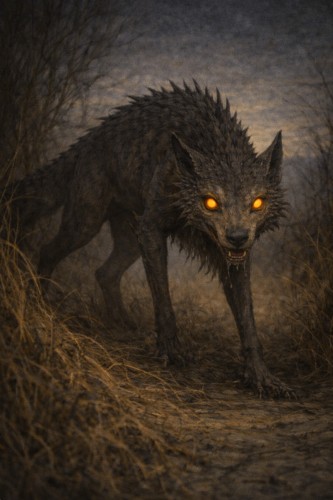
Kaelun fear the kethran, but do not treat them as monsters. When kethran keep their distance, the land is considered stable. When they follow camps for days, circle repeatedly, or behave unpredictably, elders take it as a warning that something deeper is wrong — scarce prey, poisoned ground, or the presence of a greater danger.
Despite their suspicion of keeping animals, the Kaelun are not ignorant of domestication. Travellers have seen goats tethered near Belthari orchards, dogs guarding caravans, and heavy cattle pulling ploughs. These sightings appear in memory-stone carvings and quiet debates around Kaelun fires. Some elders insist that these ways always end in sickness and loss. Others wonder whether the rule born from the Great Sickness of the Pens might one day need to change.
To the wider world, the Kaelun are often dismissed as superstitious wanderers. To those who listen, they are a living archive — a people who remember what happens when convenience replaces care, and when the wild is treated as something to be dominated rather than understood.
Saying
“Distance keeps respect.”
Common Kaelun teaching
“Walk light. Remember far.”
Traditional Kaelun farewell
Quests: Roots and Claws 1 - From Wild to Tame – Human Animal Partnerships The player travels with the Kaelun after they seek help for wolves that have begun following their camps, uncovering through quiet choices and mirror-world echoes how early humans and wolves learned to live near one another without force. By observing fear, distance, shared danger, and the slow shaping of behaviour over generations, the player discovers that domestication was not about control, but about mutual survival, trust, and change over time. The journey reveals how some animals stayed wild while others adapted, becoming partners for food, work, and protection—and how those choices reshaped both humans and animals forever.
Logic and Riddles 4 - The Order of Numbers - Patterns in Maths The player uncovers ancient Kaelun memory stones at the edge of Seven Mile Bottom, each carved with growing dot patterns that once warned their people about expansion, balance, and collapse. Through echoes of the past, the player witnesses how different patterns—triangular, square, layered, and spiral—shaped the fate of Kaelun camps, revealing why some settlements endured while others failed. By observing growth in nature, from sunflower spirals to leaf arrangements, and decoding pattern-based tattoos used to store identity and rules, the player learns that number patterns are not just maths but a language of prediction, balance, and survival.