The Kikela of Mount Kareth
The Kikela are the people of Mount Kareth, a small, quick-moving culture shaped by displacement and adaptation rather than dominance. Today, they inhabit the cave systems beneath and around the volcano, not by preference for isolation, but because these spaces offers advantages to a people who are otherwise ill-suited to open ground.
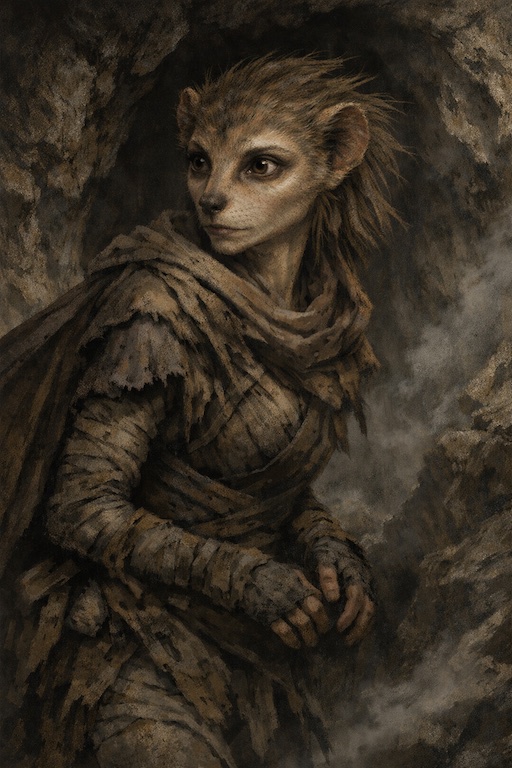
Before the period remembered as the Great Displacement, the Kikela lived on the lower slopes and surrounding lands of Mount Kareth. They were not alone. As stronger, more numerous peoples settled the region, competition for land and resources intensified. What followed was not a single decisive conflict, but a prolonged sequence of skirmishes, seasonal pushes, and forced retreats. Both Kikela and Belthari folklore recall these events, though many of the places named in their stories can no longer be identified, and it remains unclear which accounts are historical record and which are shaped by loss, pride, or later reconciliation.
The Kikela did not disappear. They withdrew.
Within the cave systems, the balance shifted. The Kikela are smaller and physically weaker than most surface peoples, but they are quick, observant, and highly responsive. Narrow passages, low ceilings, and broken lines of sight remove the advantages of size and strength. Larger groups avoid these spaces altogether, and those that enter cannot pursue effectively. The caves are not safe, but they are manageable — and far less forgiving to those who do not know them.
Kikela physiology reflects this adaptation. They are short, lean, and lightly built, with bodies suited to rapid movement and sudden retreat rather than endurance or confrontation. Their faces are human-adjacent but subtly distinct, marked by narrow structure, high cheekbones, and large, watchful eyes that favor wide awareness over fixed focus. At rest, Kikela often appear poised or unsettled, as if ready to move at short notice. This is not anxiety, but readiness shaped by generations of living where hesitation carries cost.
Kikela settlements within the caves are functional and impermanent. Living spaces are small, dispersed, and easily abandoned. There are no central halls and few enclosed stores. Paths are memorized rather than marked, and routes are valued for how quickly they allow withdrawal. Nothing is built to be defended. Everything is arranged to be left behind if necessary.
Over time, separation gave way to specialization. The Kikela developed skills suited to environments the Belthari could not safely enter: extracting mineral-rich ash, crushed volcanic stone, and potash-like salts from unstable underground deposits. These materials are essential to Belthara’s fertility, restoring exhausted soils and sustaining agriculture at scale. The Kikela supply them steadily and carefully, regulating extraction to avoid collapse or overuse.
In return, the Belthari provide grain, fruit, and preserved foodstuffs that cannot be produced underground. This exchange is not transactional in the short term, but reciprocal across generations. In years of poor harvest, the Kikela supply minerals without charge. In times of underground collapse or volcanic unrest, Belthari stores, labor, and shelter are redirected without negotiation.
The relationship between the two peoples is no longer one of competition. Each occupies a space the other cannot. The Belthari understand that their abundance is rooted in the mountain’s depths. The Kikela understand that withdrawal without support leads only to starvation. Trust between them is both practical and sentimental, reinforced through shared labor, mutual aid, and a long memory of what conflict once cost them both.
Saying
“Stand long enough to know — then go.”
Kikela saying
Prompt
Style: Semi-realistic fantasy character illustration in a grounded, painterly style. Naturalistic lighting, muted earthy colors, visible brush texture. No cartoon or graphic-novel style.
A humanoid woman from a burrowing, flight-oriented people. Her face is human-adjacent, with proportions inspired by meerkats rather than animal anatomy.
Facial structure: a narrow, tapered face with a slightly elongated mid-face; high, tight cheekbones; a small, close-set mouth; softly pointed chin. The nose bridge is short and flat with small nostrils adapted to dusty, subterranean air. Eyes are forward-facing and human in placement, but large, alert, and watchful, conveying constant vigilance. Skin shows subtle texture and dust staining — no full fur coverage, only faint, fine hair around temples and jawline.
The body is lean and upright, slightly hunched forward as if pausing mid-movement. Limbs are wiry rather than muscular. Hands are held close to the body, ready to retreat or move quickly.
Clothing is practical and worn: wrapped, layered fabrics, dust-stained and frayed, in muted browns and greys suited to volcanic caves and burrows. No ornamentation, no jewelry.
The setting is a cramped volcanic tunnel or cave chamber with rough basalt walls and drifting steam. The space feels enclosing and tight.
Lighting is low and directional, cutting across the face to emphasize bone structure, tension, and alertness rather than beauty.
Camera angle is a three-quarter side view, waist-up or full-body, not a frontal portrait. The figure is slightly off-center, as if caught mid-pause while listening.
Overall impression: a humanoid shaped by burrowing life, vigilance, and rapid flight — clearly not human, but also clearly not an animal head.