The Verdanti
Overview
The Verdanti are a sentient forest-bound people whose bodies and culture are shaped by deep symbiosis with plant life. Neither fully humanoid nor purely botanical, they exist as living extensions of the forest itself—thinking, remembering, and enduring on timescales closer to trees than animals.
Verdanti are not conquerors, builders of empires, or seekers of expansion. They are guardians, stabilizers, and witnesses, thriving where forests are ancient, light is filtered, and growth follows slow, deliberate cycles.
Habitat & Environment
Verdanti inhabit lush, old-growth forests rather than dense, chaotic jungles.
Their preferred environments are characterized by:
- Tall, mature canopies that filter sunlight
- Broad-leaf trees, mosses, and climbing plants
- Stable ecosystems with minimal seasonal extremes
- Dappled light rather than harsh, direct exposure
They avoid forests that are:
- Overly aggressive or competitive (jungles)
- Sparse or dry (woodlands in decline)
- Artificially cleared or heavily disturbed
To the Verdanti, a forest is not merely a home—it is a living network in which they are one node among many.
Appearance
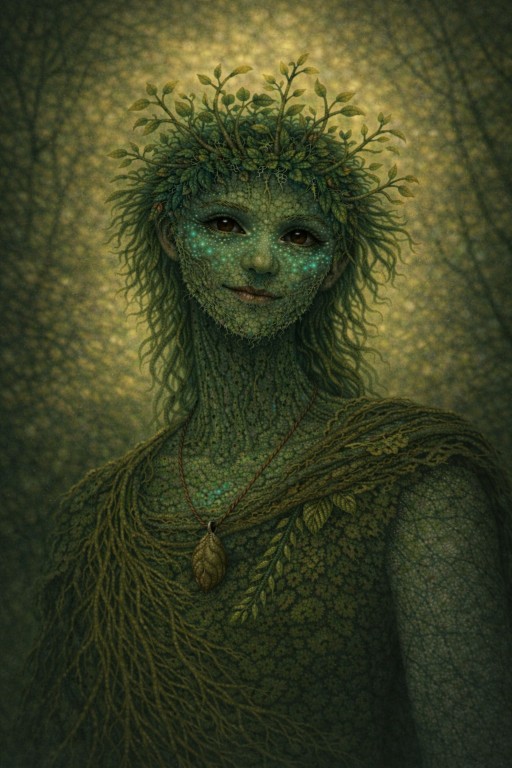
At a glance, Verdanti resemble plant-formed figures shaped into humanoid silhouettes. Closer inspection reveals that their bodies follow botanical logic rather than mammalian anatomy.
Common traits include:
- Skin composed of layered plant tissue, resembling bark, moss, leaves, or lichen
- Subtle vascular patterns visible beneath the surface, especially along the neck and shoulders
- Crown-growth in place of hair: clusters of stems, leaflets, buds, and seed-nodes
- Facial features that are recognizably sentient but softened by organic textures
Sexual dimorphism is minimal. Differences between individuals are more strongly influenced by:
- Age
- Forest region
- Seasonal cycle
- Role within Verdanti society
Biology & Physiology
Verdanti sustain themselves through a dual metabolic system:
- Photosynthesis
- Primary energy source during daylight
- Most active in the face, crown, shoulders, and upper torso
- Efficiency depends on light quality rather than intensity
- Symbiotic Nutrient Exchange
- Verdanti host complex networks of fungi and microorganisms within their tissues
- These symbionts process nutrients, store energy, and regulate internal chemistry
- The system mirrors mycorrhizal relationships found in real forests
This makes Verdanti semi-autotrophic—they do not eat as animals do, but they are not fully independent of their environment either.
Bioluminescent Freckles
One of the most distinctive Verdanti features is the presence of faintly glowing freckles, most commonly seen across the cheeks and beneath the eyes.
These are not decorative markings.
- Function Bioluminescent freckles are clusters of symbiotic microorganisms that act as:
- Photonic regulators, absorbing and redistributing excess light
- Health indicators, subtly shifting brightness with internal balance
- Emotional dampeners, preventing sudden physiological spikes
- Their glow is typically soft cyan or teal and is never bright enough to illuminate surroundings.
- Age Variation
- Younger Verdanti tend to have brighter, more numerous freckles
- Elders show dimmer, more diffuse patterns
- In times of stress or environmental imbalance, freckles may fade or flicker irregularly
Growth & Aging
Verdanti age in a manner analogous to trees rather than animals.
Life stages include:
- Sproutlings – small, leaf-heavy forms with rapid growth and vivid bioluminescence
- Mature Verdanti – balanced forms optimized for energy exchange and social roles
- Elders – slower, denser bodies with bark-like textures, lichen growth, and subdued light
Rather than becoming frail with age, Verdanti often become structurally stronger while growing less flexible.
Relationship to the Forest
Verdanti do not see themselves as separate from the forest.
They:
- Monitor changes in soil, light, and canopy health
- Act as stabilizing presences during ecological imbalance
- Rarely intervene directly unless long-term damage is imminent
When a forest thrives, Verdanti thrive. When a forest sickens, Verdanti weaken.
This bond makes them natural allies of:
- Forest spirits
- Pollinators
- Other symbiotic or non-extractive peoples
Social Structure
Verdanti society is non-hierarchical but age-weighted.
Elders
- Serve as memory-keepers and long-cycle decision makers
- Rarely issue commands; instead, they guide through consensus and precedent
- Are often physically rooted to specific forest regions
Younger Verdanti
- Act as scouts, diplomats, and observers
- More mobile and adaptable
- More likely to interact with non-forest peoples
Leadership is situational and temporary, arising from experience rather than authority.
Settlements & Dwellings
Verdanti do not construct buildings in the traditional sense.
Their dwellings are:
- Grown, not built
- Formed by encouraging living trees, roots, and vines into habitable shapes
- Gradually reshaped over decades rather than completed in moments
Settlements resemble:
- Clearings woven with living arches
- Hollowed trunks reinforced by fungal lattices
- Canopy platforms grown from intertwined branches
Nothing is permanent, and nothing is abandoned—spaces slowly return to forest when no longer needed.
Cultural Values
Verdanti culture emphasizes:
- Continuity over progress
- Balance over dominance
- Observation over intervention
- They value memory, patience, and ecological harmony, often finding the urgency of shorter-lived races puzzling or unsettling.
Relations with Other Peoples
Verdanti are generally peaceful but cautious.
They:
- Welcome respectful visitors
- Resist extractive practices
- Withdraw rather than confront unless the forest itself is threatened
- Those who harm forests may find Verdanti silent—but unyielding.
Narrative Themes
Within Wendmor, the Verdanti embody:
- Symbiosis
- Photosynthesis
- Sustainability / Global Warming
- Long-term thinking
- The cost of imbalance
- Knowledge accumulated over generations
They serve as a living counterpoint to fast-moving civilizations and linear progress.
Prompt
Style & Contract Traditional fantasy illustration in the Wendmor Storybook Illustration Contract style. Painterly, organic, textured, and illustrative. No anime influence. No hyper-realism. Natural brushwork, soft lighting, and a storybook quality consistent with other Wendmor characters.
Subject A young female Verdanti, equivalent to a late teenager or young adult. She is a plant-being, not a humanoid — shaped by growth rather than anatomy. Her form reflects new life, adaptability, and curiosity, rather than age or authority.
Face & Body The face is formed from smooth leaves, young bark, moss, and fine vine structures, softer and more flexible than an elder’s. Features are gently asymmetrical, grown rather than carved. No human skin, pores, or hair — all surfaces are vegetal in nature. The neck and upper torso resemble slender stems and young branches, layered with thin bark and leaf-vein patterns. The transition from face to body feels continuous, like a plant rising upward.
Eyes & Expression Eyes are slightly larger than the elder’s, dark and reflective, set within leafy growth. Expression is open, calm, and quietly curious — welcoming but not playful. She appears attentive, observant, and thoughtful, as if learning the forest rather than guarding it.
Bioluminescence Bioluminescent freckles scattered across cheeks, nose bridge, and temples. Glow is more visible than in elders: soft turquoise-green points, irregular and organic. Suggests youthful vitality and active growth, never decorative or symmetrical.
Crown / Head Growth Instead of hair, her head is crowned with thin, flexible stems and young leaves, gently arching and overlapping. Includes leaf buds and unfurled new growth, but no flowers or mushrooms. Growth feels lighter, airier, and more mobile than an elder’s dense canopy. Some tendrils may frame the face, but never resemble hair.
Color Palette Dominant fresh jungle greens, brighter than elders but still shaded and natural. Accents of spring green, soft moss, olive, and hints of bark brown for contrast. Avoid yellow tones; greens should feel alive, damp, and forest-shaded.
Clothing & Accessories Simple, organic garment made from woven vines, leaf fibers, and thin roots. Lighter and less layered than an elder’s attire. May wear a small natural token — a seed pod, leaf charm, or vine knot — subtle and symbolic.
Composition Portrait framing from mid-torso upward, consistent with Wendmor character portraits. She faces the viewer or slightly three-quarters, maintaining gentle eye contact. Background is a soft, abstract jungle canopy, lighter than the elder’s, with filtered green light. Background remains secondary and painterly.
Mood Lush, youthful, and grounded. A being of growth and potential — not naïve, but not yet burdened by centuries. She feels like the future of the forest.