Thiravel Wood
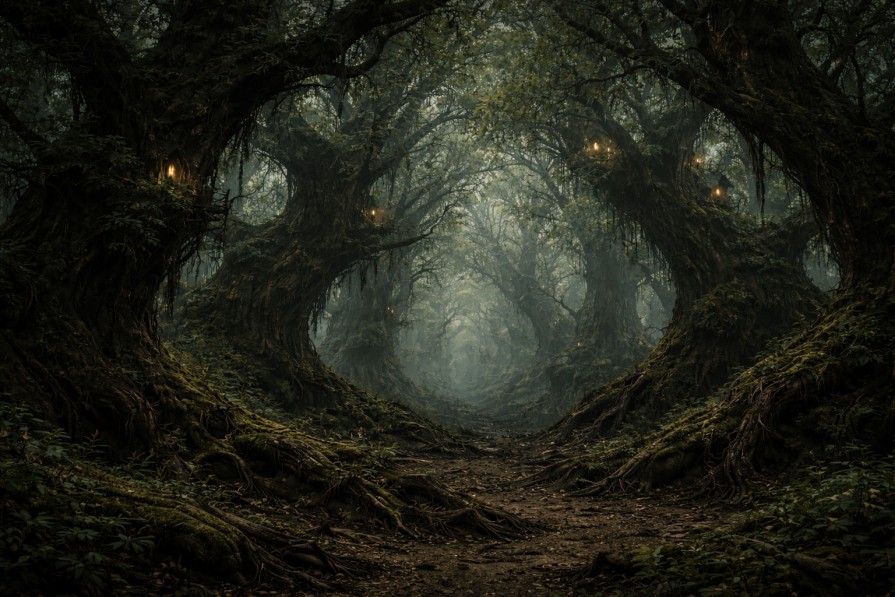
Thiravel Wood (Oldgrowth Forest)
Description
Thiravel Wood is an ancient temperate forest of extreme age, forming part of the Oldgrowth Reaches. The forest is composed entirely of vast, gnarled oak and pine trees shaped by centuries of slow, uneven growth. No tree grows straight: trunks lean, twist, and spiral into one another, roots rise above the soil, and heavy branches interlock to form a dense canopy that blocks nearly all sky. Light within the wood is dim and uneven, filtered through layers of moss, leaves, and age-darkened bark, giving the forest a heavy, enclosed, and timeless character.
Deep within the upper boughs of Thiravel Wood lies the hidden settlement of Caelthir, woven directly into the living trees. Its presence is subtle and easily missed, known to outsiders only through rumor and faint evening lights glimpsed high among the branches. To those who do not belong, the area is often referred to as the High Boughs of Thiravel, though few ever truly find it. Thiravel Wood is not merely a forest that shelters life, but a place shaped by endurance, memory, and quiet persistence, where habitation is inseparable from the living wood itself.
Reputation
Among neighboring settlements, Thiravel Wood is spoken of with caution rather than fear. Travelers tell of paths that bend without warning, of distances that feel longer beneath the canopy, and of lights glimpsed high in the trees that vanish when approached. It is said that the forest does not bar entry, but neither does it guide the unwelcome back out.
Most warnings agree on one point: Thiravel Wood endures those who pass through, but it does not hurry for them. Those who linger too long without purpose are said to lose their sense of direction — not through trickery or malice, but through the forest’s quiet indifference to time, urgency, and intent.
Map
Prompt
Style: Semi-realistic fantasy landscape illustration, grounded and naturalistic, with restrained fantasy elements and no overt magic.
A vast, ancient temperate forest known as Thiravel Wood, viewed at a wide regional scale. The forest is composed entirely of extremely old oak and pine trees, with no straight or young growth anywhere in the scene. Every trunk leans, twists, arcs, spirals, or splits — shaped by centuries of slow, uneven growth. Even distant trees resolve as crooked, irregular silhouettes rather than vertical lines.
Tree trunks are thick, gnarled, and deeply fissured, many growing into one another or crossing at strange angles. Roots bulge above the soil and interlock across the forest floor. Heavy branches curve sideways and downward, some broken or dead but still attached, forming a dense, tangled canopy that blocks nearly all sky. The canopy feels accumulated and weighty, not layered or airy.
The forest interior shows strong tonal variation: some areas sink into deep shadow, while others glow with richer, saturated greens where moss, ferns, and ancient foliage are especially dense. This contrast is slightly exaggerated to give the forest a subtle mythical presence — not through magic, but through depth, color, and age.
Light is heavily filtered and uneven, green-brown and muted, reaching the ground only in irregular patches. Mist hangs lightly between trunks, softening depth without glowing. The forest floor is dark, dry, and crowded with exposed roots, fallen trunks left where they fell, deep layers of compacted leaf litter, moss, fungi, and soil built up over centuries. Any moisture is fully absorbed into the ground, bark, and moss, with no visible streams, pools, or standing water.
High in the distant canopy, a few faint, warm points of light may be barely visible, ambiguous and easily mistaken for reflections or fireflies — subtle enough to be missed at first glance, hinting at habitation without revealing it.
The color palette is restrained but deep: dark forest greens, muted olive tones, bark browns, greys, and pockets of richer green contrasted against heavy shadow. No visible sky, no clearings, no paths. The forest feels enclosed, ancient, and enduring — a place shaped entirely by time rather than events.