Stillmarch
Stillmarch
Stillmarch is a tidal expanse where light fails to establish certainty. Low fog lies over the flats with unusual permanence, muting daylight until it feels more like a prolonged dusk than morning. Horizon and shoreline rarely resolve clearly, and distance becomes difficult to judge.
The river does not hold its shape here. Channels spread, narrow, and reform without reliable pattern, and marks that were trusted on one crossing may be absent on the next. Current, sound, and visibility do not agree long enough to sustain bearings. Even experienced pilots report moments when the water seems to erase direction.
Loss in Stillmarch is rarely dramatic. Vessels drift out of view, crews separate, and returns do not align with departure. Some arrive late to places they should have reached hours earlier. Others do not arrive at all. Charts are revised often, yet confidence does not accumulate.
Stillmarch matters because it is the only passage toward the inner riverlands and the legendary Aurelion Gorge beyond. Stories of hidden storeholds and untouched treasure continue to draw attempts. The water continues to refuse familiarity. Many have entered. Few have returned.
Quests
No quests currently recorded.
Map
Prompt
Style: Semi-realistic fantasy landscape illustration, naturalistic and restrained, with no overt magic.
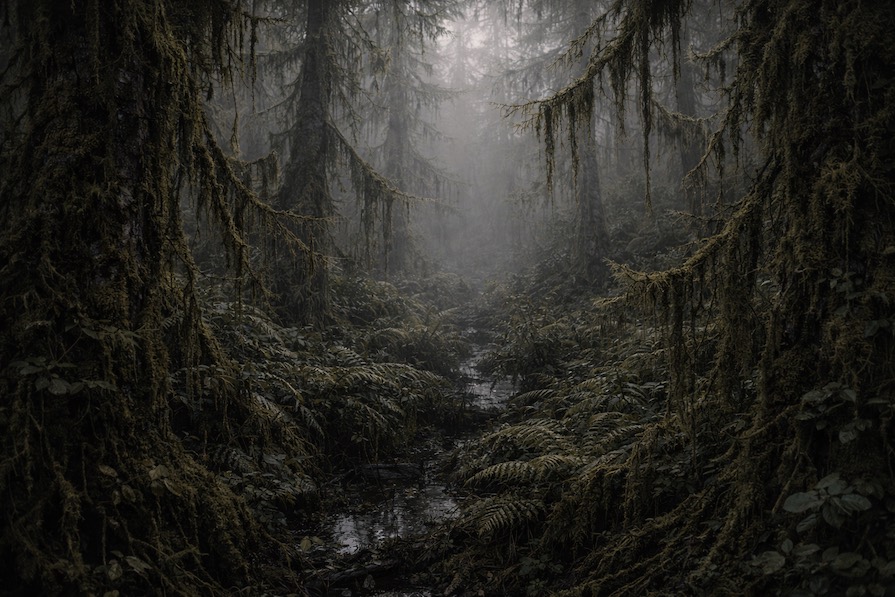
Camera position is deep inside an impenetrable swamp forest. The immediate foreground is dominated by massive, irregular tree trunks standing very close to the viewer. Several trunks partially block the frame from left and right, creating a sense of being enclosed by wood and bark. The trees are tall, unevenly spaced, and twisted, with dark, water-soaked bark.
The trunks and branches are heavily overgrown with moss, algae, and long strands of bearded lichen hanging down in thick curtains. Lichen and moss are the dominant visual texture, clinging to trunks, limbs, and hanging from branches overhead.
The canopy is dense and interlocking. Branches overlap and fill most of the upper image, blocking light and preventing any clear view of the sky. Visibility is short; trees fade quickly into fog, and depth collapses after a few meters.
The ground is mostly obscured by roots, fallen logs, and shadow. Where visible, it is dark, muddy, and uneven. Ferns and low plants exist only as secondary elements, growing between roots and against trunks, never dominating the scene.
Water is barely present. There is no visible stream, river, or open channel. Only occasional damp patches, shallow puddles, or thin seepage appear between roots, mostly hidden by vegetation and darkness.
Heavy fog hangs throughout the forest, thickest between the trees. The horizon is completely unreadable. Repeating vertical forms and overlapping silhouettes make orientation difficult and distances hard to judge.
Lighting is dim and diffuse, filtered entirely through canopy and fog. Despite being daytime, the forest feels dark and enclosed. No sunbeams or highlights break through.
Color palette is cold and organic: deep moss greens, grey-greens, blue-greys, dark wet browns, and dull silvery tones on lichen and damp surfaces. No warm colors.
The overall impression is claustrophobic density and obstruction — a hostile swamp forest defined by trees, trunks, and vertical mass, where movement feels nearly impossible and passage is denied by sheer overgrowth.