Malrecor
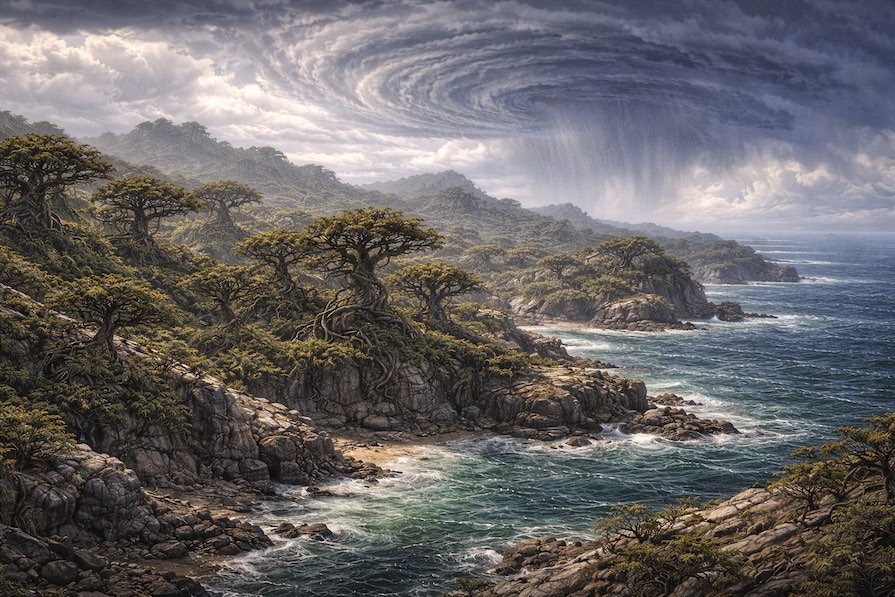
Malrecor
Core Identity
Malrecor is an island shaped by repetition rather than catastrophe. For centuries, it has sat beneath a persistent storm system whose center rarely drifts far. Calm exists here, but only conditionally, framed by cycles of violent collapse and renewal.
This is not a ruined land. It is a land that has learned how to endure being tested again and again.
Landscape & Geological Form
Malrecor’s terrain bears the marks of constant atmospheric pressure.
- Rock faces are rounded and undercut rather than fractured
- Cliffs show layered erosion from wind-driven rain rather than tectonic break
- Inland high points are scoured smooth, with shallow basins where water collects during collapse phases
- The coastline is irregular, shaped by repeated storm surge rather than steady tides
The island lacks sharp geological drama. Instead, it feels worn, compressed, and dense — a place where force has been applied so often that extremes have been smoothed away.
Vegetation & Growth
Vegetation on Malrecor reflects adaptation to rotational wind and sudden stress.
- Trees grow with twisted trunks and asymmetrical crowns
- Many species show helical grain patterns and reinforced root systems
- Coastal growth leans inland, while interior vegetation coils and overlaps, forming dense, interlocking canopies
Plants favor flexibility over height. Breakage is expected; regrowth is rapid. Nothing grows straight long enough to become fragile.
Inland Coilwoods dominate much of the island, their spiral forms marking the long reach of the storm system even during calm periods.
Fauna & Adaptation
Animal life on Malrecor favors timing, shelter, and awareness.
- Burrowing species retreat ahead of pressure changes
- Birds nest low and wide, using rock overhangs and tangled growth
- Coastal creatures migrate inland during collapse cycles, returning when calm resumes
Many animals display heightened sensitivity to air pressure, sound, and vibration. Flight and movement often precede visible weather change, giving the island an uneasy sense of anticipation.
Predation here is less about pursuit and more about patience.
Human Presence
Human habitation is limited to a few sheltered zones, most notably the free haven of Tortugena, built where terrain and wind patterns offer relative protection.
Elsewhere, signs of past attempts remain:
- Abandoned footings
- Collapsed watch posts
- Half-reclaimed clearings
Permanent settlement is possible, but only through adaptation rather than control. Structures must bend, be rebuilt, or be allowed to fail without consequence.
Emotional Impression
Malrecor feels conditional.
- Calm is real, but never guaranteed
- Safety exists, but must be read rather than assumed
- The land feels alert, not hostile
Visitors often describe the island as watchful — not threatening, but attentive, as if it remembers every collapse it has survived.
Narrative & Quest Hooks
Common story themes include:
- Predicting storm collapse through environmental signs
- Recovering items revealed by erosion or regrowth
- Navigating the island during false calm
- Learning why some paths survive every cycle while others do not
- Choosing when to stay, and when to leave
Prompt
Style: Semi-realistic fantasy landscape illustration, grounded and naturalistic, with restrained fantasy elements and no overt magic.
A rugged island landscape shaped by constant storm systems. The terrain shows rounded cliffs, smoothed rock faces, and wind-worn slopes rather than sharp peaks. Vegetation is dense and twisted: spiral-trunked trees, asymmetrical canopies, and interlocking growth adapted to repeated high winds.
The atmosphere is heavy and layered. Above the island hangs a vast storm ceiling: curving cloud bands, low pressure haze, and uneven light. Rain curtains and darker weather loom in the distance, while parts of the island remain calm beneath the system’s center.
The coastline is irregular and weathered, with signs of erosion from storm surge rather than gentle tides. Inland, dense Coilwoods dominate, their forms visibly shaped by rotational force.
Color palette is natural and subdued: dark greens, weathered browns, wet stone greys, muted blues, and soft highlights where light breaks through cloud cover. The overall impression is resilience through repetition — a land shaped by force, but not defeated by it.