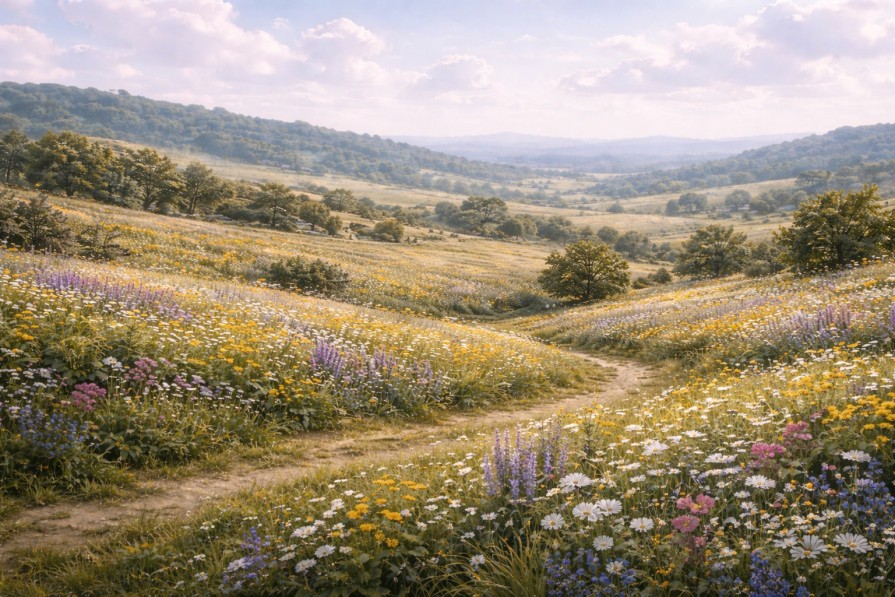
Florayne
Florayne is a land shaped by overlap rather than force.
Warm water moves in from the west, carried by the Grand Verdant, a broad, slow river that feeds the
soil with silt and heat. From the east, cold currents and air spill outward from
Ithral, thinning warmth and shortening growing seasons as they advance.
Nothing in Florayne resolves cleanly. Temperature, moisture, and light shift gradually across short distances, producing a landscape where conditions are rarely uniform and rarely extreme. What grows here does so through adaptability rather than dominance.
Florayne does not present itself all at once. Its character is revealed through movement — a change in grass underfoot, a sudden pocket of flowers, the hum of insects thickening or thinning with the air.
Atmosphere & Perception
Florayne feels alive in layers.
Air is mild but unsettled. Warmth drifts unevenly across the land, interrupted by cooler currents pressing westward from Ithral. Mornings are often cool and clear, with warmth building slowly rather than arriving decisively.
Sound is constant but gentle: wind through flowering grasses, water moving through shallow channels, and the steady presence of insects. The land feels active but unhurried — responsive rather than demanding.
To travelers, Florayne can feel inconsistent. A dry path may soften into damp ground. A meadow may give way to wet growth or scrub without warning. The land rewards attention rather than speed.
Landscape & Life
Florayne follows the rolling forms of the Meadowslopes, but its surface is continually interrupted by water and variation.
Low hills fold into shallow basins. Seasonal streams branch outward from the western river, spreading warmth and nutrients unevenly before thinning toward the east. As cold influence increases, plant life shifts gradually toward hardier, cool-tolerant species without clear boundaries.
Flowering plants are present throughout Florayne, but species distribution varies over short distances. Wet meadows support dense, fragrant growth; higher, drier rises favor smaller blooms and resilient grasses; sheltered folds host early woodland plants and shade-tolerant herbs.
Insect life is abundant and diverse. Pollinators move constantly across the landscape, and many plants depend on specific insects found only in narrow conditions. During warmer months, the region carries a low, continuous hum, as much airborne as rooted.
Florayne is defined less by any single habitat than by the sheer number of them.
Human Relationship
People in Florayne live by working with variation rather than attempting to erase it.
Settlement is widely dispersed. Small hamlets and isolated dwellings appear wherever a particular set of conditions proves reliable enough to support specialized plant growth. Each community tends its immediate surroundings rather than a broad territory, developing deep familiarity with a narrow ecological range.
As a result, local expertise is highly specialized. Some settlements are known for honey drawn from specific flowering cycles, others for medicinal plants, pigments, spices, resins, or preserved botanical compounds that cannot be produced elsewhere. Knowledge is practical, inherited, and closely guarded, passed down through observation rather than instruction.
Cultivation is selective and adaptive. Plants are encouraged, protected, and sometimes relocated, but rarely forced into rigid arrangements. The land is read continuously, not mastered.
Trade & Exchange
Florayne’s diversity gives rise to exchange.
Rather than a single dominant industry, the region supports a web of small-scale production. Goods move outward from hamlets to a central coastal harbor town, where plant-based products are traded, combined, or redistributed.
The harbor is modest in size but busy in rhythm. Small boats arrive constantly, carrying goods from along the coast and nearby rivers. Markets are dense with variety: stalls, workshops, and narrow storefronts offering specialized products rather than bulk trade.
Florayne’s traders are known less for volume than for distinction. Many goods are produced nowhere else, tied to precise conditions that cannot be replicated outside the region.
Proximity to Ithral makes the harbor an important point of contact. The Velari regularly travel west to obtain supplies unavailable in the ice — remedies, preserved plants, dyes, and materials that support life without resisting it. These exchanges are practical, restrained, and longstanding.
Emotional Impression
The dominant impression of Florayne is richness through variation.
- Diverse
- Adaptive
- Industrious without excess
- Quietly abundant
Florayne feels neither wild nor orderly. It is a place where life persists by finding its niche, and where abundance emerges from attention rather than scale.
Quests
No quests currently recorded.
Map
Prompt
Format / Composition Wide landscape illustration suitable for a computer screen. A broad, open viewpoint looks across gently rolling hills and open meadowland, with the terrain rising and falling in soft, continuous waves. The horizon is distant and calm, with hills fading gradually into atmospheric depth.
No buildings or settlements are visible anywhere in the scene.
Subject Florayne is a temperate meadow region defined by expansive, continuous flower-rich grasslands. The land feels shaped by long seasons of growth rather than by erosion or human design. The scale is broad and open, emphasizing continuity rather than landmarks.
Vegetation & Ground Cover Meadows are dense with wildflowers and medicinal plants of many shapes, heights, and colors. Whites, soft yellows, muted purples, pale blues, pinks, and layered greens dominate the scene.
Plants grow in natural clusters rather than rows. Low ground cover blends into taller flowering stems, seed heads, and grasses. Density varies gently across slopes, creating texture without chaos. Growth feels abundant, balanced, and well-adapted to the land.
Scattered small trees and shrubs appear irregularly, never forming forests or groves.
Paths & Land Use Narrow footpaths wind through the meadows, formed by long use rather than construction. Paths are earth-toned, lightly worn, and irregular, guiding the eye through the landscape without dominating it.
No roads, fences, walls, or markers are present.
Atmosphere & Light Soft daylight, likely late morning or afternoon. Light is warm but restrained, with gentle shadows and no dramatic contrast. The air feels mild and breathable, carrying movement through grasses and flowers rather than mist or haze.
The mood is calm, fertile, and attentive, suggesting land that rewards observation rather than force.
Style Semi-realistic fantasy landscape illustration, grounded and naturalistic. Painterly realism with restrained fantasy elements. No overt magic, glowing effects, or exaggerated forms.
Color Palette Natural meadow tones: layered greens, floral pastels, warm earth notes, and soft sky blues. Saturation is moderate — rich enough to convey biodiversity without becoming luminous or surreal.
Explicit Exclusions No settlements, houses, or buildings of any kind No coastlines or visible sea No towns, farms, or cultivated fields No mountains, cliffs, or dramatic terrain No overt magic effects No prominent characters or animals in the foreground No architectural silhouettes on the horizon