Belthara
Belthara
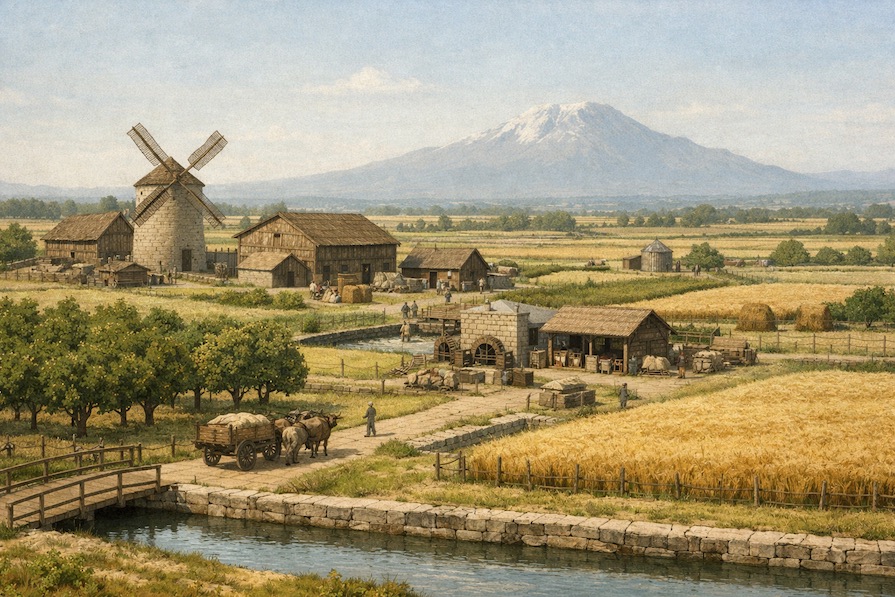
Belthara is a broad riverland shaped by accumulation rather than motion. Over long periods, fine mineral silt has settled across its plains, building deep, dark soils that hold water and nutrients with unusual reliability. The land is flat but not featureless, structured by channels, embankments, and long-established boundaries that guide both river and labor.
Much of Belthara’s fertility comes from deposits carried downstream from Mount Kareth. Volcanic minerals, broken down and dispersed over time, have enriched the soil without leaving visible signs of their origin. The result is a landscape that appears calm and settled, yet quietly powerful in what it can sustain.
Farming here is extensive and deliberate. Fields stretch wide, managed through carefully maintained waterways, mills, and storage yards rather than seasonal flooding. Grain, fruit, and staple crops are produced at scale, not through speed or novelty, but through continuity and planning.
Belthara does not draw attention to itself. Its importance lies in dependability. The region feeds cities, supports trade, and absorbs disruption without spectacle. In Wendmor’s rhythms, Belthara provides the steady foundation upon which more visible centers of culture and industry rely.
Quests
No quests currently recorded.
Map
Prompt
Style: Semi-realistic fantasy landscape illustration, grounded and naturalistic, with restrained fantasy elements and no overt magic.
Foreground focus: a row of mature fruit trees in the immediate foreground, viewed from eye level. The trees are evenly spaced and clearly cultivated, with rounded canopies, visible trunks, and branches heavy with fruit. Grass and worked soil beneath them show regular maintenance rather than wild growth. The fruit trees frame the lower edge of the image and establish depth.
Beyond the foreground orchard stretches a vast, highly agricultural plain shaped by long-term human management. Wide grain fields extend across the landscape in large, regular plots, divided by straight boundaries, access roads, and drainage channels. Belts of orchards continue into the distance, arranged in orderly rows that echo the foreground trees.
Industrial and processing structures are integrated into the farmland: mills, presses, granaries, silos, and storage buildings clustered near roads and canals. Light smoke rises from processing yards. Carts and wagons move along roads, and barges travel through canals carrying produce toward distant markets.
A river is present but secondary, running along one side of the scene as part of the infrastructure rather than the visual focus.
Lighting is calm and even, suggesting reliable seasons and predictable work. The light emphasizes texture in leaves, grain heads, and soil without dramatic contrast.
Color palette is realistic and restrained: rich greens of fruit trees, golden grain fields, muted orchard greens, dark fertile soil, weathered wood, pale stone, and soft water blues.
The overall impression is scale, productivity, and continuity — a landscape that feeds the world through order, planning, and sustained human effort rather than spectacle.