Caelthir
(also known as 'The High Boughs of Thiravel Wood')
Description
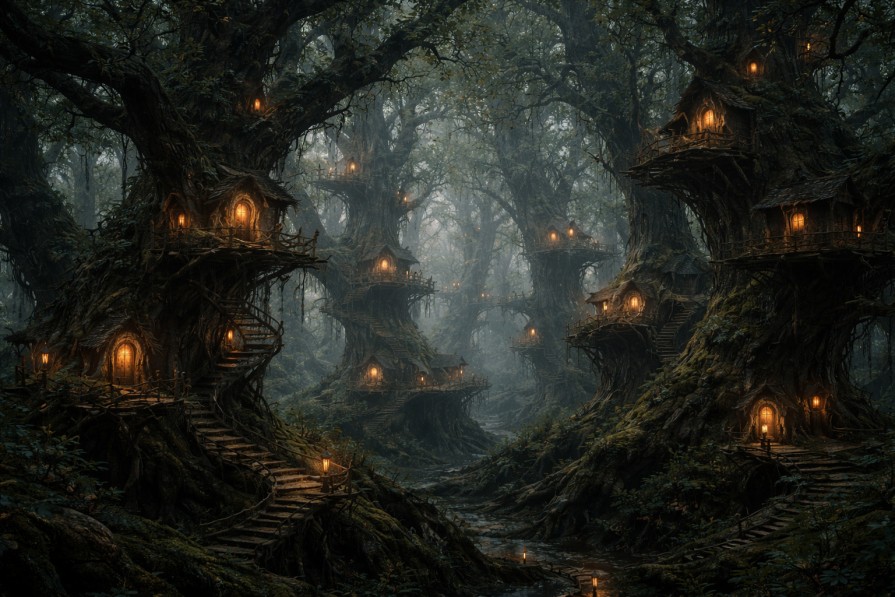
Caelthir lies hidden deep within Thiravel Wood, woven into the living bodies of the forest’s oldest trees. The settlement does not rise so much as cling and curve, its homes and walkways grown around leaning trunks and heavy branches shaped by centuries of slow, uneven growth. Spiral stairs wind upward along crooked bark, and small dwellings are carved directly into living wood, their forms bending to the will of the trees rather than resisting it. At early evening, warm lantern light glows softly from high windows and doorways, scattered like quiet thoughts among the boughs, while the forest below remains dark, root-bound, and hushed.
To those who belong, the Strighel, this place is Caelthir — a name spoken with familiarity and restraint, carrying meanings older than any record. Outsiders, who rarely enter the forest and never stay long, know it only as the High Boughs of Thiravel, a distant cluster of lights glimpsed through mist and twisted branches. They see a settlement perched above the forest floor; the people of Caelthir know it as something far older and deeper — not a refuge from the wood, but a continuation of it, shaped by patience, memory, and enduring knowledge.
Prompt
Style: Semi-realistic fantasy environment illustration. Ancient, grounded, and naturalistic. Painterly realism with high texture detail. No exaggerated fantasy forms.
An ancient woodland settlement embedded deep within the Oldgrowth Reaches — a dense temperate forest composed entirely of extremely old trees. Oak and pine dominate, and no tree grows straight upward at any distance. Every trunk leans, arcs, spirals, twists, or splits, shaped by centuries of slow, uneven growth. Even distant trees resolve as crooked, irregular silhouettes rather than vertical lines.
Tree trunks are thick, gnarled, and wildly varied in direction and width. Bark is dark, deeply fissured, and layered with heavy moss and lichen. Roots bulge above the soil and interlock across the forest floor. Branches curve downward or sideways, many broken or dead but still attached, forming a heavy, tangled canopy that blocks nearly all sky. The forest feels saturated with age at every level — foreground, midground, and background alike.
The settlement is woven into this forest rather than placed upon it. Treetop dwellings and platforms wrap around leaning trunks and crooked branches, following their irregular shapes. Some homes are carved directly into living wood, with rounded doorways and windows set into the bark. No straight lines appear in the architecture — all structures bend, tilt, and adapt to the trees’ forms, as if grown slowly over generations.
Winding staircases spiral unevenly around slanted trunks, rising at different angles rather than vertically. Narrow walkways and bridges connect branches that dip and curve, their paths slightly warped and asymmetrical. The settlement feels layered and vertical, but never orderly or aligned.
It is early evening. Ambient forest light is dim and heavily filtered, green-brown and blue-grey in tone. Warm lantern light glows softly from treetop windows and doorways — subtle, amber, and human-made rather than magical. The lanterns provide small islands of warmth within the vast, dark forest, suggesting study, memory, and quiet habitation.
The forest floor below is dark and uneven, crowded with exposed roots, fallen trunks left where they fell, deep leaf litter, moss, ferns, and fungi. Water appears only as slow, dark pools and hidden rivulets, partially obscured by roots and shadow.
A thin mist hangs between trunks, catching faint lantern light and softening depth without glowing. The color palette remains restrained: deep forest greens, dark browns, greys, muted olive tones, soft amber highlights, and cool dusk blues.
The mood is ancient, enclosed, and contemplative. This is a place of accumulated knowledge and endurance — a settlement that feels as old as the forest itself, shaped by patience and time rather than construction.