The Grove of Verdelune
Description
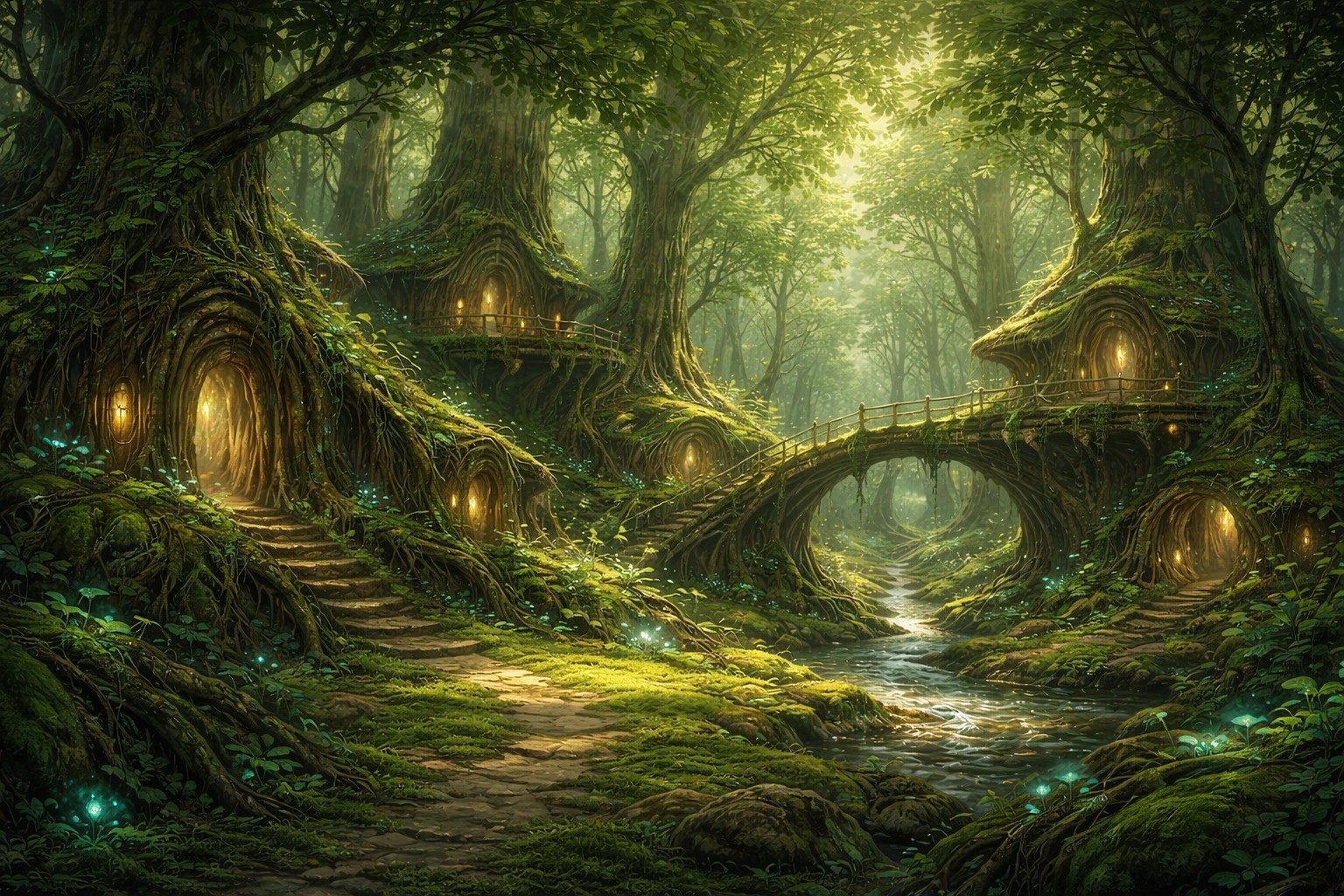
The Grove of Verdelune is the primary settlement of the Verdanti, hidden deep within the heart of the Verdant Veil. Rather than being built, the grove is grown — shaped slowly through guidance, symbiosis, and careful stewardship of living trees whose roots, trunks, and canopies form homes, walkways, and communal spaces.
Verdelune is not arranged around streets or squares, but around layers of life. Woven root-paths follow the forest floor, elevated bridges arc between trunks and boughs, and softly lit hollows within ancient trees serve as dwellings. The settlement shifts subtly with the seasons, its forms thickening, shedding, or blooming in response to light, moisture, and the needs of its inhabitants.
At dusk, the grove comes alive with faint bioluminescence. Verdanti markings, mosses, spores, and leaf-growths emit a gentle glow, guiding movement through the forest without disturbing its natural rhythms. Warm lamplight and small flame-lanterns are used sparingly, reserved for gathering spaces and shared rituals, lending the grove a sense of quiet refuge rather than brightness.
Social life in Verdelune centers around shared stewardship. There are no rigid borders between private and communal space; instead, families and circles tend to particular trees, roots, or glades, passing responsibility down through cycles of growth. Elders guide the long rhythms of the grove, while younger Verdanti learn to listen to the forest’s signals — light, scent, and subtle changes in growth.
To outsiders, the Grove of Verdelune can appear almost invisible, its paths obscured and its dwellings indistinguishable from the forest itself. This is by design. Verdelune exists not as a place set against the Verdant Veil, but as one of its living expressions — a settlement that breathes, grows, and rests alongside the forest that sustains it.
Quests
No quests currently recorded.
Map
Prompt
A semi-realistic fantasy landscape illustration depicting a Verdanti forest dwelling grown organically within an ancient lush forest.
The scene is wide and cinematic, designed as a landscape background for an in-game screen. Towering old-growth trees form a high canopy overhead, filtering sunlight into soft green shafts that dapple the forest floor.
The dwellings are not built structures but living formations: gently hollowed tree trunks, woven root arches, and branch platforms grown into natural curves. Vines, moss, and broad leaves form doorways and railings, while fungal growths and lichen reinforce living walls. No sharp edges, no cut wood, no stone — everything appears grown, shaped slowly over decades.
Subtle bioluminescent elements are visible: faint teal and cyan glows from moss clusters, fungal caps, and leaf veins embedded in the structures, suggesting life and energy rather than artificial light. The glow is gentle and atmospheric, never bright.
The forest feels calm, ancient, and balanced — not wild or chaotic. The ground is layered with roots, leaves, and soft moss rather than underbrush. Small clearings connect the dwellings like natural paths, with no roads or tools visible.
Color palette is dominated by deep jungle greens, mossy emeralds, muted browns, and bark tones, broken occasionally by soft cyan bioluminescence. The mood is serene, wise, and timeless.
Style: semi-realistic fantasy landscape illustration, grounded and naturalistic, painterly textures, soft depth of field, no exaggerated fantasy architecture, no modern elements, no visible technology.