The Stoneholds of Alrenfjell
Description
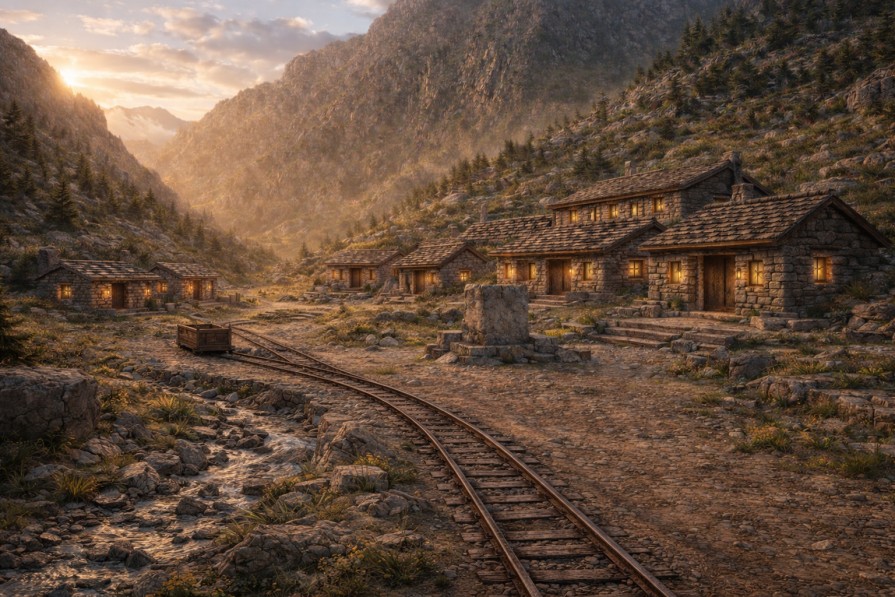
The Stoneholds of Alrenfjell are the primary residential quarters of the Helvars, carved directly into the lower quarry slopes of Mount Helvar. Rather than a planned settlement, the Stoneholds are an accumulation of hollowed chambers, stacked stone shelters, and reinforced platforms shaped over generations as quarry work expanded downhill. Their forms are blunt and functional, with thick walls, deep-set entrances, and minimal interior separation, reflecting a culture that values durability and practicality over comfort or ornament.
The Stoneholds vary in scale and depth, accommodating Helvars of different sizes and roles. Larger, older holds with heavier stonework sit higher along the quarry face, while smaller and shallower dwellings occupy the lower terraces. Rail lines, loading platforms, and shared work spaces run continuously through the settlement, blurring the boundary between home and labor. During festivals and rest periods the Stoneholds serve as communal gathering grounds, but for most of the year they remain quiet extensions of the quarry itself—places of rest embedded within the mountain rather than built upon it.
Quests
No quests currently recorded.
Map
Prompt
Format: Landscape (16:9) Usage: In-game background / wiki illustration Style: Semi-realistic fantasy landscape illustration, grounded and naturalistic, painterly realism, high texture detail, no exaggerated fantasy elements
Prompt:
A wide landscape view of the Stoneholds of Alrenfjell, a quarry settlement carved directly into the lower slopes of a massive mountain. The scene shows multiple terraced quarry levels descending diagonally across the image, with stone dwellings of subtly varying scale embedded into the rock face and built from stacked, rough-cut stone slabs. Some holds are noticeably larger and deeper, with thicker stone blocks and taller openings, while others are more compact and shallow, suggesting different Helvar sizes and roles.
Heavy stone trolley rails run prominently through the scene, bolted into the rock and supported by rough stone buttresses and short bridges. One or two empty wooden stone carts rest on the rails near loading platforms, emphasizing the industrial purpose of the settlement. The rails slope downhill and disappear out of frame, implying a much larger quarry system beyond what is visible.
The quarry walls are scarred with clear signs of labor: chisel marks, wedge fractures, tool wear, and exposed layers of stone in varying tones. Broad stone platforms serve as shared work and gathering spaces, seamlessly blending residential and industrial areas.
The surrounding mountains rise steeply behind the settlement, their upper slopes partially obscured by mist and low cloud. The lighting is cool and natural, late afternoon or early evening, with soft sunlight catching the edges of stone and casting long shadows across the terraces. A faint haze of stone dust hangs in the air, adding depth and scale.
The settlement appears empty and still, as if between shifts — no people or animals visible. The overall mood is monumental, practical, and lived-in, shaped by generations of work rather than design. Nothing is ornamental or symmetrical; everything feels adapted, reinforced, and repaired as needed.