The Town of Calenne
Description
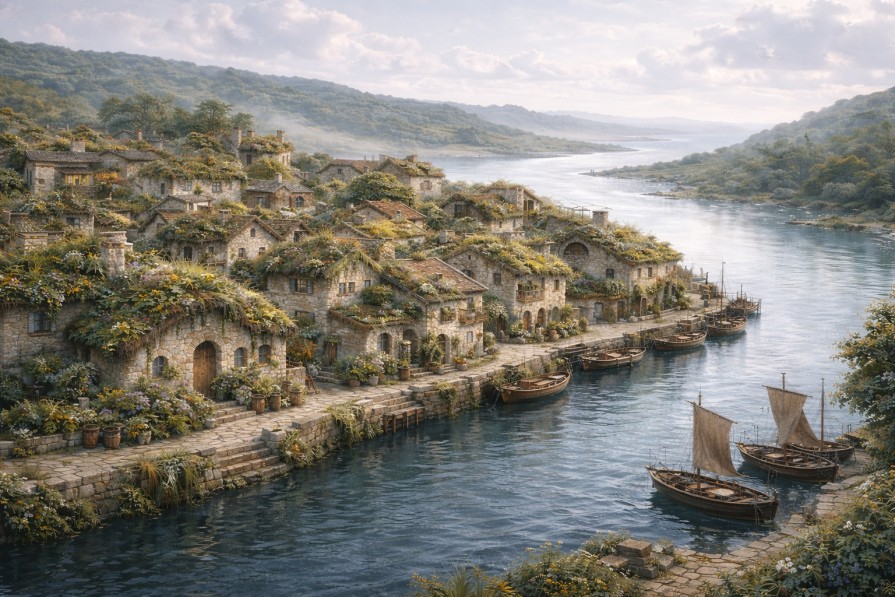
Calenne is a modest harbor settlement on the eastern edge of Florayne, set within a natural bend of river and sea. The town occupies the west bank of a broad river that curves around it from the north and east before turning south and flowing into the ocean.
This geography places Calenne on a narrow wedge of land, bordered by water on three sides. To the north and east, the river presses close, slow-moving but deep enough to carry trade boats and river craft. To the south, the river’s mouth opens into the sea, forming a shallow, protected inlet rather than an exposed coastline.
The landward approach from the west is the town’s only open connection to the Florayne interior. As a result, Calenne feels gathered and enclosed, shaped more by flow and access than by walls or defenses.
Mist is common where river water meets colder coastal air, especially in the mornings. The influence of Ithral is felt here more sharply than inland, cooling the air and shortening the growing season without extinguishing it entirely.
Calenne does not dominate its surroundings. It sits within them, held in place by water.
Role & Rhythm
Calenne functions as Florayne’s primary point of exchange.
Goods flow inward from the surrounding hamlets and outward toward neighboring regions. Small boats arrive continuously rather than in fleets, each carrying narrowly specialized cargo: crates of dried herbs, sealed jars of honey, bundles of dyed cloth, pressed plants, oils, resins, spices, and remedies prepared far inland.
The town’s rhythm is constant rather than intense. There are no grand arrivals or departures — only steady movement, negotiation, and redistribution. Markets shift with the seasons, and stalls change hands frequently as products rotate and conditions elsewhere fluctuate.
Settlement & Structure
Calenne is compact and functional.
Buildings cluster close to the water, built from timber and stone with minimal ornamentation. Many roofs and upper surfaces are planted, retaining grasses, herbs, and hardy flowering plants in shallow beds framed by stone or timber. Greenery is not decorative but functional, providing insulation, cultivation space, and continuity with Florayne’s surrounding landscapes. Trailing plants soften walls, balconies, and quays, guided by beams and gutters rather than left to spread unchecked.
Markets dominate the town’s interior. Some are open-air, others sheltered under wooden awnings or within low, enclosed halls. The boundaries between shop, workroom, and stall are often blurred, with goods prepared, refined, and sold within the same space.
Despite its trade focus, Calenne remains small. Expansion is constrained by climate, terrain, and the limits of the harbor itself.
Trade & Visitors
Calenne’s position near Ithral makes it a familiar destination for Velari.
The Velari do not linger, but they return regularly, acquiring materials unavailable in the ice — plant-based remedies, dyes, preserved foods, and crafted goods that support life without excess. These exchanges are practical, quiet, and longstanding.
Trade in Calenne is built on distinction rather than scale. Many goods sold here cannot be reproduced elsewhere, tied as they are to specific habitats deeper within Florayne. Reputation matters more than volume, and traders are known by what they specialize in rather than how much they sell.
Emotional Impression
Calenne feels busy without feeling crowded.
- Varied
- Industrious
- Grounded
- Attentive
It is a place of meeting rather than arrival — a settlement defined by exchange, specialization, and the constant movement of small things.
Quests
No quests currently recorded.
Map
Prompt
Format / Composition Wide landscape illustration suitable for a computer screen. A slightly elevated, angled viewpoint looks across a modest harbor town set on a narrow wedge of land between river and sea. Water surrounds the town on three sides: a broad, slow-moving river curves in from the north and east, while a sheltered inlet opens southward into the ocean.
The landward approach from the west is visible but understated, with buildings appearing gathered inward rather than sprawling outward.
Subject Calenne is a compact, layered town built along riverbanks, terraces, and narrow streets. Buildings are primarily two to three stories tall near the water, becoming lower and more spaced toward the western edge. The town feels dense but not crowded, shaped by access and flow rather than by walls or defenses.
Architecture Buildings are constructed of pale stone, plaster, and weathered wood, softened by age and plant growth rather than ornament. Rooflines are varied and stepped, following the contours of the land and river rather than forming a uniform skyline.
Many buildings feature living roofs, thinner and more structured than those of rural Florenne settlements. Low stone borders, wooden frames, or shallow terraces retain soil and vegetation. Roof plantings are practical and deliberate, favoring grasses, herbs, and hardy flowering plants rather than wild growth.
Botanical Integration Plants are integrated throughout the town in controlled, purposeful ways: window boxes filled with herbs, hanging planters along streets, trellised greenery climbing walls, and small courtyard gardens tucked between buildings. Trailing plants spill gently from roof edges, balconies, and upper windows, guided by beams, gutters, and supports rather than growing unchecked.
Vegetation becomes more salt- and moisture-tolerant closer to the river and harbor.
Relationship to Water Stone quays, embankments, and steps clearly descend into the river, with a visible waterline along all embankments. Small docks extend over the water, and all boats are floating clearly in the river, with visible water beneath their hulls and subtle reflections on the surface. No boats rest on dry stone or land.
Moored river craft sit close to buildings, emphasizing trade and movement without spectacle. The harbor feels enclosed and calm rather than open or exposed.
Environment & Atmosphere Mist is common, especially in the morning, where river water meets cooler coastal air. Light is diffuse and cool-toned, softening edges and blending stone, water, and greenery. The influence of Ithral is present but restrained, cooling the air without suppressing growth.
In the far distance beyond the river valley, the landscape subtly transitions toward the edge of the Kelnor Tundra. Hills flatten and vegetation thins, colors becoming paler and more desaturated. Growth appears lower and sparser, with a faint frost-grey cast beneath atmospheric haze. This shift is distant and understated — a quiet suggestion of cold held at bay by climate rather than terrain.
Style Semi-realistic fantasy settlement illustration, grounded and naturalistic. Restrained fantasy elements only. No overt magic, glowing effects, or fantastical structures.
Color Palette Cool river blues, muted sea greys, soft meadow greens, pale stone, warm plaster tones in the town, and cooler, desaturated hues toward the far horizon.
Explicit Exclusions No towering fortifications No dramatic cliffs or storms No grand monuments or palaces No overt magical symbols or effects No dominant foreground figures (optional small distant figures only)