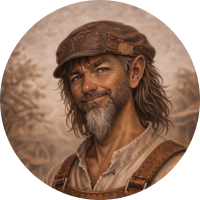
Riku
Details
- Name: Riku
- Age: Appears end-50s
- Gender: Male
- Occupation: Tanner
- Origin: Seven Mile Bottom
Character
Riku believes the world should be simple.
Not because it always was, but because simplicity feels correct to him. He values routine, familiarity, and outcomes that can be seen and handled. Work should produce something solid. Food should satisfy. Explanations should be brief.
When the world grows complicated, Riku does not try to understand it. He assumes something unnecessary has been added.
He is polite, contained, and rarely argumentative. Rather than pushing back, he declines. Rather than debating, he repeats what already works. His resistance to change is quiet and consistent, expressed through habit rather than confrontation.
Riku is particularly drawn to stories that confirm his sense that the wider world has become overthought and absurd. He believes such stories readily, especially when they frame complexity as foolish or self-inflicted. They reassure him that his own way of living remains sane.
Appearance
Riku has a solid, compact build shaped by decades of physical labor rather than strength for display. His posture is steady and economical, with movements that waste little effort and follow long-established routines.
Age shows clearly in his face. His features are broad and settled, the lines worn in by repetition rather than hardship. His expression is calm and resolved, suggesting decisions made long ago and rarely revisited. Pale grey eyes sit heavy-lidded beneath a low brow, observant but uncurious.
His hair is worn long to the chin, roughly and unevenly cut, allowed to fall naturally around his head and partially over his ears. It is ash-brown shot through with grey, more grown than styled. A simple grey goatee frames his mouth, kept short and practical without care for grooming.
He dresses plainly in work-worn clothes suited to tanning and animal handling: a faded linen shirt beneath a heavy leather vest or apron, the hide darkened to a rich tan by age, staining, and repeated repair. Nothing he wears is decorative. Everything shows use.
He carries with him the faint, persistent scent of leather, smoke, and animal fat — a smell that lingers even when he has been away from his workshop for hours.
Background
Riku was born among the Capren of Safira, a rain-soaked lowland shaped by Kelmar grazing and Lazuliberry growth. His family had worked the same land for generations, herding Kelmar and tanning their hides into leather known across Wendmor for its durability and resistance to wet and cold. The work was slow, physical, and dependable. It had never made anyone wealthy, but it endured.
He ended up in Seven Mile Bottom due to a clever scam. Riku never admits that he has been the victim of a scam despite obvious evidence. This is how he lost his farm in Safira:
The Sting
1. The Raffle
Each year, the Capren gather at the farmer’s market at Kelmar Quay, and each year there is a farmer’s raffle. The Capren enjoy it. It feels communal, harmless, and lucky rather than commercial.
That year, thousands of tickets were sold across Safira, yet only seven prizes were drawn: luxury cruises to the Kelmar Leather Manufactury in Lowhaven. By extraordinary coincidence, all seven winners came from the same neighbourhood — Blue Hide Manor, including Riku. Two of the winning tickets had not even been purchased by their holders, but gifted by a pleasant woman who insisted everyone should be able to share in the raffle excitement.
Riku still calls it “the one time all the luck of a lifetime came together.”
2. The Cruise
The cruise was lavish. Fine food, abundant Ambra, private cabins with sea views, and a night spent anchored in Lowhaven harbour beneath fireworks and city lights. Nothing was sold. Nothing was explained.
During the visit, the Capren were shown finished leather goods. Some were made from Kelmar hide. Others were made from different leathers entirely — duller, thicker, cheaper to produce. These sold quickly, despite exorbitant prices and visibly lower quality.
Riku remembers customers openly disparaging Kelmar leather. Old-fashioned. Out of date. Still stitched instead of glued. He laughed at them then, and still does now.
“Those fools in Lowhaven,” he says. “Can’t spot quality if it hits them in the face.”
3. The Recession
The following year was difficult. The wholesaler struggled to move stock and could not commit to buying the usual volume of hides. Blue Hide Manor was hit hardest.
The explanation was simple: their leather smelled unpleasant.
Riku rejected this outright. Leather had always smelled like leather. It always would. This was not new. But the wholesaler insisted that buyers in Lowhaven had become sensitive, refined, particular. The leather from Blue Hide Manor, he said, could not be sold that year.
Riku blamed fashion, snobbery, and fine noses.
4. The Lifeline
As Riku began to draw down his savings, he met a distant relative at the inn — a second cousin thrice removed. A genial man. Successful. Confident.
The cousin spoke of a place called Seven Mile Bottom, where he had run a highly profitable tannery using other farm animals. The land, he claimed, was three times the size of Riku’s farm, produced seven times the leather, and sold for twelve times the price. He had made his fortune there.
Now old and retired, he wanted something smaller. Something familiar. A modest plot in Safira to keep himself busy. He complained that no Capren had the courage to take over his former land.
Riku bristled at that. He said he would take such an opportunity without hesitation — if only he had the means. All he had left, he said, was his small farm.
The cousin suggested a swap. Riku accepted.
5. Seven Mile Bottom
He acquired a plot at the south-west corner of Seven Mile Bottom and resumed tanning. The leather was inferior. The work was harder. Demand for cheap leather collapsed almost as quickly as it had appeared. Kelmar leather returned to fashion.
Riku blamed Lowhaven’s fickle tastes.
When others suggested that no tanner had ever worked his land before, Riku dismissed them.
“Yea, yea,” he says. “You and your tall tales. I met the man. He ran a successful tannery here for decades.”
Riku still makes a living. It is less profitable than before, but sufficient. He does not describe what happened as a scam.
He describes it as how things turned out.
Relationships
Bella defends Riku without hesitation. To her, he represents continuity. She serves him what he wants because asking would imply a choice he does not seek.
Azar amuses himself by telling Riku exaggerated tales of the wider world, particularly stories that cast cultured places like Lowhaven in a ridiculous light. Azar knows these stories are embellished. Riku believes them. They confirm his sense that complexity leads to nonsense.
Viktor baffles Riku. He does not consider Viktor’s work to be real labor and views Mirror World research as time spent explaining rather than doing. Even when such knowledge benefits him directly, Riku refuses to acknowledge Viktor’s role. Accepting the value of that work would undermine his understanding of how the world should function.
Luna attempts to meet Riku at the minimum level required for animal welfare. She avoids theory and focuses on practical outcomes. Riku listens politely, but keeps his distance. Even small increases in complexity feel intrusive to him.
Nalani is one of the few people Riku openly respects. He recognizes in her a similar acceptance of limits and a lack of ornament in how she lives. Nalani, in turn, appreciates that Riku understands simplicity as discipline rather than ignorance.
Worldview
Riku draws a clear line between the world as it should be and the world as it is. When reality fails to match his expectations, he does not revise the expectation. Instead, he concludes that the world has been made unnecessarily complicated.
Exaggerated stories of failure help him maintain this boundary. They allow him to believe that refusing change is not avoidance, but good sense.
His way of life does not work especially well. He depends on others more than he admits. But acknowledging that would require him to cross the boundary he has built.
So he does not.
Quote
“If it needs that much explaining, it’s already gone wrong.”
Prompt
A human villager from Seven Mile Bottom, shown from mid-torso upward, suitable for use as a speaking character in a fantasy storybook game.
Riku is a man in his late 50s to early 60s, compact and solidly built, shaped by decades of repetitive physical labor rather than strength for display. His posture is steady and economical, conveying long familiarity with routine and effort conserved through habit.
His facial structure shows subtle South-East-Asian–influenced traits, rendered in a simplified, illustrative manner rather than realistic: broader cheekbones, a calm mid-face, and a softened, squared jaw. Age is clearly visible through heavier facial planes, deeper lines, and reduced skin elasticity, without exaggeration or caricature.
His expression is composed and resolved — polite, contained, and emotionally restrained. He appears settled rather than expressive, as if his opinions were formed long ago and rarely revisited.
Eyes: His eyes are a distinct pale light grey, cool-toned and slightly desaturated. They are heavy-lidded and low in reflectivity, observant but uncurious. The grey eye color should remain clearly readable even at small sizes.
Hair: Riku’s hair is chin-length, roughly and unevenly cut. The hair falls naturally around the head, partially covering the ears. Length is irregular, with blunt ends and no shaping. No modern styling: no spiking, no layering, no tapering, no texture lift. Hair is rendered as a single, heavy mass, suggested through broad painterly shapes rather than individual strands. The silhouette is simple and gravity-led, shaped by neglect rather than intention. Hair color is muted ash-brown with extensive greying throughout.
Beard: He wears a simple grey goatee-style beard, practical and minimally maintained. Short moustache and chin beard Soft, irregular edges Facial hair suggested through texture, not sharp detail
Clothing: He wears plain, work-worn clothing suited to tanning and animal handling: A rough linen shirt in faded bone or tallow tones A heavy leather work vest or apron in a rich tan leather color, clearly associated with processed hide The leather shows visible age through uneven staining, wear, and repair, emphasized with broad painterly marks. Nothing is decorative. No jewelry, embroidery, or ornamentation.
Color Palette: Restrained but rich natural tones: warm umbers, bark browns, rich tan leather, smoke tan, muted olive. Colors retain depth without brightness or polish.
Background: The background is impressionistic and abstract, with no literal objects. A soft gradient halo is present behind the head and upper shoulders, lighter at the center and gently darkening toward the edges. Background tones are muted and subdued, ensuring clear on-screen separation and legibility of the face and hair. Texture is lighter and less dense than the character, so it does not compete visually.
Style: Hand-drawn, storybook fantasy illustration. Ink-wash and dry-brush textures. Forms are simplified and symbolic rather than realistic. Selective clarity: emphasis on face, eyes, and silhouette, with softer treatment elsewhere. No photographic realism, no cinematic lighting, no modern grooming cues.
The final image should feel illustrated rather than rendered, visually consistent with Bayak, Viktor, and the other Wendmor villagers — a man shaped by time, habit, and repetition.