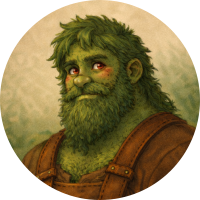
Alaric
Details
- Age: Late 30s
- Gender: Male
- Clan: Belthari
- Occupation: Farmer, Cultivator
- Hails from: Belthara - a broad riverland, downstream from Mount Kareth
Character
Alaric is steady, practical, and quietly observant. He speaks little unless there is purpose in doing so, and when he does, his words tend to land with weight. He believes that most problems are solved not through urgency but through patience, repetition, and showing up every day.
He is deeply rooted in Belthari ideas of responsibility — to land, to community, and to future generations. Alaric is not resistant to change, but he is skeptical of anything that promises quick gains at the cost of long-term stability. He measures success in seasons, not moments.
Though not outwardly warm, he is dependable to a fault. When help is needed, Alaric arrives without being asked and stays until the work is done. Trust, to him, is not spoken — it is demonstrated.
Quote
“The field doesn’t care what you hope for. It remembers what you do, season after season.” - Alaric, the Farmer
Appearance
Alaric has the broad, heavy-set build typical of the Belthari, shaped by years of physical labor rather than combat. His skin carries a muted green, mineral-toned hue, sun-darkened and weathered from long hours in open fields. Freckles and uneven pigmentation mark areas most exposed to light.
His hair and beard are thick, coarse, and unstyled, kept only as short as practicality demands. His eyes are calm and deep-set, often appearing tired but alert. He wears durable, well-maintained work clothing — leather overalls, reinforced belts, and tools carried as extensions of habit rather than readiness for conflict.
Nothing about Alaric is ornamental. Everything he wears has endured.
Home
Alaric lives in a sloped, sunlit cottage on the eastern edge of Seven Mile Bottom, where the wild herbs start to take root. His roof garden is quiet, practical, and always in use. In the fields surrounding his cottage, he grows fruit and vegetables — sold in his Harvest Farm Shop.

Background
Belthari folklore is rarely taken seriously beyond Belthara.
Across Wendmor, the Belthari are known as tireless workers and reliable suppliers, but their stories are often treated as quaint at best and laughable at worst. Their legends rarely speak of kings or conquerors. Instead, they celebrate remarkable harvests, stubborn ingenuity, and improbable agricultural feats — the farmer who grew a zucchini so large it fed a village for a week, or the ancestor who climbed Mount Elbrin and stole the secret of crafting watering cans from the stone-bound beings said to dwell there.
Among these stories are older, less comfortable tales: the Mirror Crops.
Beans that cause uncontrollable flatulence. Onions that make even the hardest Belthari cry when cut. Pumpkins said to grow faces and glow faintly from within.
Most Belthari repeat these stories with a grin. Few believe them.
Alaric does not repeat them at all.
He came to Seven Mile Bottom because it was the kind of place where such things might still happen — or fail honestly. Close enough to odd alignments to invite strangeness, but far enough from scrutiny to allow quiet persistence. Officially, he tells people he came because the village needed a farmer and he knew how to grow food reliably.
This is true.
It is simply not the whole truth.
Privately, Alaric has always wondered whether the old stories were wrong — or whether no one had ever been patient enough to prove them right. He keeps this goal close, partly out of habit, partly out of embarrassment. He knows how Belthari tales sound to outsiders. He has no desire to become the subject of someone else’s joke.
So he works.
He plants ordinary crops alongside strange ones. He tends beds no one asks about. He records failures only in his head and tries again the following season. If something behaves oddly, he does not announce it. He watches.
On rare evenings, usually after a mug of mulled elderberry tea at The Wyrm’s Wing, he may let something slip — a half-sentence, a vague admission, a comment about how a crop behaved almost the way the stories said it would.
The villagers listen. They nod. They do not press.
Most of them have known his real goal for some time. They simply allow Alaric the dignity of believing his secret remains intact.
In Seven Mile Bottom, that kind of patience is understood.
Role in Seven Mile Bottom
Alaric runs the village farm and Harvest Farm Shop, supplying Seven Mile Bottom with fresh produce, preserved foods, and dependable seasonal staples. His work is quiet, consistent, and rarely discussed — which is precisely why it matters.
Beyond his fields, Alaric serves as the village’s quiet corrective. When plans grow overambitious, tempers flare, or ideas outrun practicality, he is often the one who slows the conversation. He does not argue. He asks simple questions. He reminds people what will still matter in a week, a season, or a year.
Prompt
Semi-realistic fantasy character illustration rendered in a hand-drawn, symbolic style with visible linework and subtle ink-wash or dry-brush textures. Interpretation is prioritized over realism: forms are simplified, edges softly broken, and surface detail is suggested rather than fully resolved.
Alaric, a male of the Belthari, a near-human agricultural people shaped by soil, moisture, and long seasonal labor rather than speed, elegance, or dominance.
The upper body remains in a relaxed three-quarter orientation, angled slightly away from the viewer. Shoulders and torso do not face front and retain a natural, working posture. The head is turned independently from the body and rotated back toward the viewer so the face is fully visible despite the angled torso. Eyes look directly at the viewer, making clear eye contact. Pupils are centered and aligned toward the camera, not off-axis. The gaze is calm, steady, and attentive — emotionally present but restrained, never intense, confrontational, or heroic.
His anatomy avoids heroic or cinematic human proportions. The neck is shortened, with the head appearing slightly embedded into the shoulders. Shoulders slope downward, and the upper torso is broad and weight-bearing, with a subtle forward lean shaped by years of working close to the ground.
Facial structure is subtly non-human: a heavier, lower brow ridge; a wide, soft jaw without sharp angles; a broad nose with a low bridge; and eyes set slightly deeper into the face. His expression is calm, patient, and observant, conveying understanding rather than intensity.
Skin is earth-green, uneven in tone like clay, moss, or leaf-stained soil rather than flat coloration. Color variation includes olive, lichen green, muted yellow-green, and warm soil undertones, giving the skin body and depth without brightness or gloss.
Hair and beard are green, coarse, and biologically grown rather than styled. Hair continues naturally down the back of the neck and merges into beard and upper chest, with visible body hair on shoulders and collarbone. Color ranges through deep moss green, olive, and darker root tones, avoiding flat desaturation.
Eyes are reddish-brown, soil-like and expressive, with subtle warmth and internal variation. Eye whites are muted and natural, not bright. The gaze remains readable at small sizes.
Clothing consists of simple, functional agricultural workwear. Materials resemble worn leather and heavy fabric, rendered in rich bark browns, oiled leather tones, and muted rust accents chosen for depth rather than dullness. Textures are implied through mark-making rather than sharp material realism. There is no ornamentation or heroic detailing.
Shading is tonal and painterly rather than cinematic. Lighting is soft and diffuse, but colors retain pigment and weight rather than collapsing into greys. There is no rim lighting, dramatic highlight, or photographic depth of field.
The background is lightly suggested only, with hints of fields, low vegetation, or earth-toned interior forms. It remains subdued and slightly darker or less saturated than the figure so Alaric remains the clear focal point.
The overall impression is grounded, adult, and quietly mystical — a being deeply connected to land and seasons, clearly non-human in structure yet emotionally relatable, and visually readable within a stylized 2D fantasy game interface.