Twinewoods
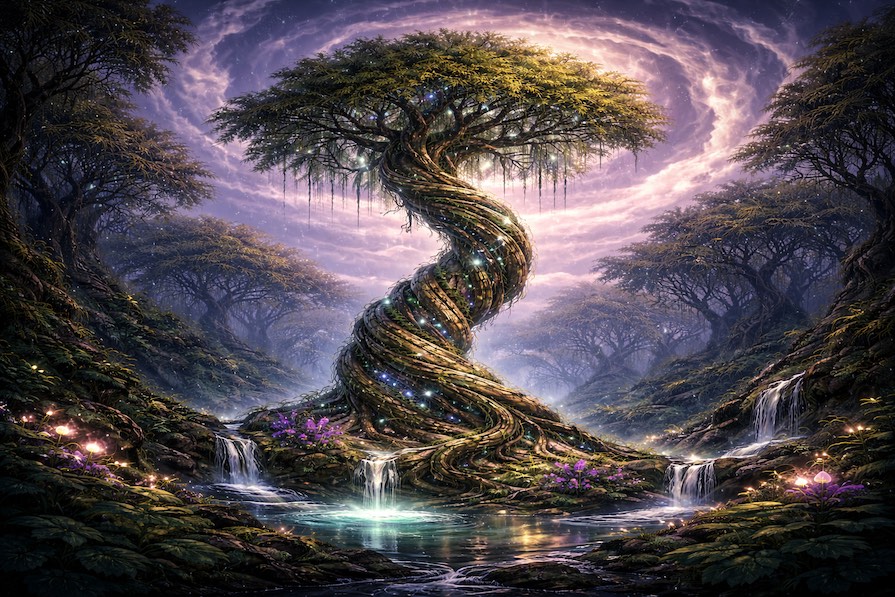
The Twinewoods (Storm-shaped woodland)
Core Identity
The Twinewoods are forests shaped by repetition rather than climate. They form in regions dominated by long-lived storm systems whose centers periodically stabilize, creating cycles of calm followed by violent collapse.
This biome is defined by endurance through motion. Growth here is not optimized for stillness, but for survival under repeated rotational force.
Nothing in the Twinewoods grows straight for long.
Landscape & Physical Form
Twinewoods occupy terrain that experiences alternating phases of shelter and exposure.
- Periods of calm allow dense growth and regeneration
- Collapse phases bring spiralling winds, driving rain, and salt-laden air
- The land bears visible memory of previous cycles in layered damage and regrowth
Ground forms are uneven but stable.
- Shallow basins and wind-scoured ridges
- Accumulations of fallen and regrown timber
- Clearings formed by past collapses, now reclaimed
The terrain feels resilient rather than fragile, shaped to absorb force instead of resist it.
Vegetation & Life
Vegetation in the Twinewoods is defined by flexibility and recovery.
- Spiral palms along exposed edges, trunks curved by repeated wind wrapping
- Twinewood trees inland, tall hardwoods with helical grain and twisted crowns
- Interlocking branches that distribute stress across the canopy
Common plant traits include:
- Flexible trunks and limbs
- Thick, waxed leaves resistant to salt and abrasion
- Growth patterns that favor bending over height
- Rapid regrowth after breakage
Nothing here is delicate. Survival favors plants that can be damaged repeatedly without failing.
Light, Color & Atmosphere
Light shifts dramatically between phases.
During calm periods:
- Warm, open sunlight
- Clear air and high visibility
- A sense of ease that contrasts sharply with surrounding regions
During collapse periods:
- Rapidly moving cloud layers
- Rotational haze and driven rain
- Fragmented light and unstable shadow
Color palette:
- Sun-warmed greens and pale bark tones in calm phases
- Weathered greys, deep blues, and dark wood during collapse
- Subtle scarring visible in trunks and canopy
The atmosphere never feels settled for long.
Human Relationship
Humans do not settle Twinewoods casually.
- Permanent structures are rare and reinforced
- Communities rely on prediction, not defense
- Knowledge of storm cycles is essential for survival
- Travel is timed, deliberate, and conservative
Those who live within Twinewoods learn to read pressure, wind, and sound rather than sky alone. Outsiders often mistake calm for safety.
Emotional Impression
The dominant emotional tone is conditional comfort.
- Inviting
- Resilient
- Uneasy beneath the surface
- Always temporary
Twinewoods feel alive, capable, and patient — a landscape that tolerates habitation only from those who accept its rhythm.
Narrative & Quest Hooks
Common story themes include:
- Timing movement between collapse cycles
- Repairing settlements after rotational damage
- Reading environmental signs to predict change
- Discovering relics exposed by storm stripping
- Choosing whether to remain when calm returns
Prompt
Style: High-detail fantasy digital painting, cinematic lighting, rich texture, painterly realism.
A single mystical tree standing at the center of a forest clearing. The tree’s trunk twists upward in a strong spiral, coiling around itself from roots to canopy. The bark follows the spiral tightly, with layered ridges wrapping like a helix rather than bending smoothly.
The trunk is slightly thinner than a normal ancient tree, emphasizing the corkscrew motion. Fine roots and vines cling to the spiral grooves, reinforcing the rotational structure.
Above the tree, the sky forms the calm eye of a massive hurricane: swirling cloud bands rotate in a wide circle around a still, luminous center directly above the tree. No lightning, no destruction — only motion, scale, and tension.
The environment glows softly with bioluminescent plants and reflected light. Color palette: deep greens, gold highlights, cool violets and blues in the sky. The tree is the unmistakable focal point, centered, monumental, and otherworldly.