The Oldgrowth Reaches
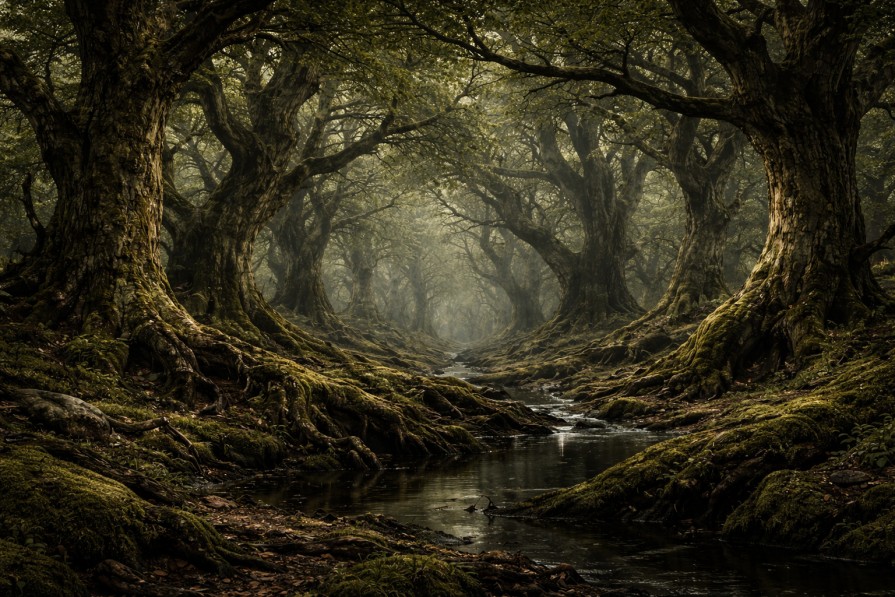
The Oldgrowth Reaches (Ancient Forest)
Core Identity
The Oldgrowth Reaches are forests defined not by growth, but by persistence. This is land that has not been cleared, replanted, or reset within living memory. Every tree, root, and fallen trunk is part of a continuous ecological history stretching back centuries.
Unlike other forests, the Oldgrowth Reaches do not feel dynamic or seasonal. They feel settled, saturated with time, and resistant to change. Nothing here is young, and nothing is in a hurry.
Landscape & Physical Form
The terrain is uneven and enclosed, shaped by accumulated growth rather than erosion or design.
- Ground is crowded with exposed roots, fallen trunks, and deep leaf litter
- Soil is dark, compacted, and rarely visible in clean patches
- Water gathers slowly in shallow pools, root-choked channels, and hidden rivulets
- Clear paths are rare; movement is dictated by gaps between roots and trunks
The land feels inward-facing, with limited sightlines and a strong sense of enclosure.
Vegetation & Life
Vegetation is dominated by extremely old oak and pine trees, with no visible young growth.
- Trunks are twisted, leaning, split, or arcing — no tree grows straight
- Bark is thick, deeply fissured, and irregular
- Roots bulge above ground, interlocking with one another
- Branches are heavy and uneven, many broken or dead but still attached
Understory plants exist, but sparingly:
- Mosses, ferns, fungi, and shade-adapted plants thrive
- There is no clear vertical stratification; everything feels compressed by age
The forest appears ecologically stable but slow, with life adapted to scarcity of light rather than competition.
Light, Color & Atmosphere
Light is scarce and heavily filtered.
- The canopy is dense, tangled, and interlocking
- Sunlight reaches the ground only in dim, irregular patches
- Light has a muted green-brown tone
Color palette:
- Deep forest greens
- Dark browns and greys
- Muted olive and moss tones
The air feels still, cool, and heavy, as if sound and movement are absorbed by the forest itself.
Human Relationship
Humans do not shape the Oldgrowth Reaches — they adapt to it or avoid it.
- Permanent settlements are extremely rare or nonexistent
- Travel is slow and cautious; routes are learned, not built
- Locals may know safe passages, landmarks, or ancient clearings
- Outsiders often underestimate the forest’s density and disorientation
The forest is not hostile, but it does not accommodate ignorance.
Emotional Impression
The dominant emotional tone is weight and endurance.
- Timeless
- Enclosed
- Patient
- Quietly overwhelming
The Oldgrowth Reaches inspire reverence rather than fear, and humility rather than urgency.
Narrative & Quest Hooks
Typical story themes include:
- Recovering something lost long ago and left undisturbed
- Navigating by memory, landmarks, or inherited knowledge
- Encounters with remnants of earlier cultures reclaimed by the forest
- Tests of patience, orientation, and respect for the land
Prompt
Style: Semi-realistic fantasy landscape illustration, grounded and naturalistic, with restrained fantasy elements and no overt magic.
A dense ancient temperate forest composed entirely of extremely old trees, with no visible young or straight growth at any depth. Oak and pine trees dominate, their trunks twisted, gnarled, and irregular throughout the entire forest, including the midground and distant background.
No tree grows straight upward: trunks lean, arc, spiral, or split, shaped by centuries of slow, uneven growth. Even distant trees resolve as crooked silhouettes rather than vertical lines. Bark is thick and deeply fissured, roots bulge above the soil, and trunks vary wildly in thickness and direction.
Heavy, uneven branches curve downward or sideways, many broken or dead but still attached, forming a tangled, interlocking canopy that blocks most of the sky. The canopy feels heavy and accumulated, not layered or airy.
The forest floor is dark and uneven, crowded with exposed roots, fallen trunks left where they fell, deep leaf litter, moss, ferns, and fungi. Water appears only as slow, dark pools and hidden rivulets, partially obscured by roots and shadow rather than open streams.
Light is heavily filtered and green-brown in tone, reaching the ground only in dim, irregular patches. There is no clear understory gradient — the forest feels saturated with age at every level.
Colors are deep forest greens, dark browns, greys, and muted olive tones. The atmosphere feels heavy, enclosed, and timeless, suggesting extreme age and long endurance rather than danger, fantasy, or decay.
There are no glowing elements, no magical effects, no creatures, no clearings, and no signs of recent growth — only accumulated time and quiet persistence.