The Canopy Wilds
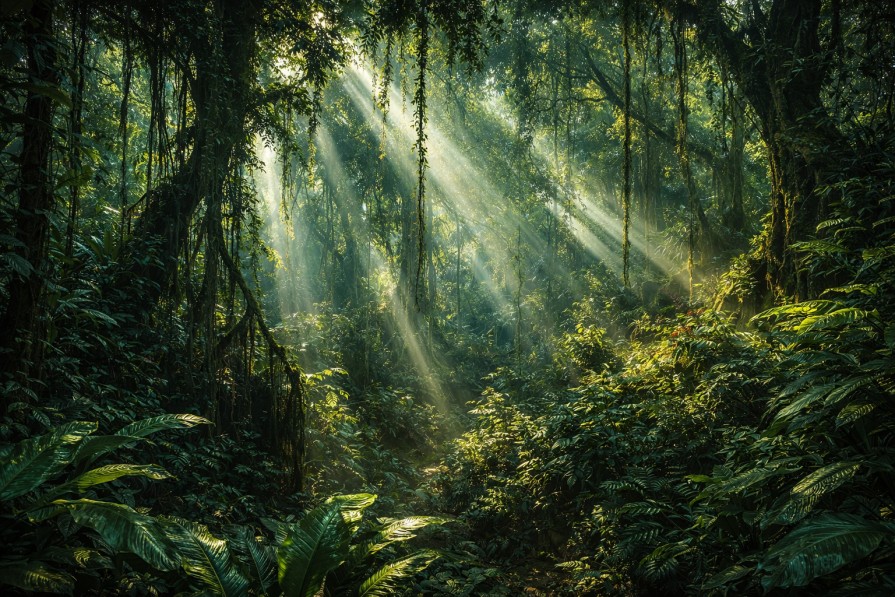
The Canopy Wilds
Core Identity
The Canopy Wilds are forests defined by vertical dominance. Here, life does not primarily exist on the forest floor, but above it — in branches, vines, suspended growth, and layered canopy systems.
This is a jungle-like biome where sunlight, moisture, and competition have driven vegetation upward. The forest feels crowded, abundant, and alive, with no single level of importance.
The Canopy Wilds are not ancient or quiet — they are relentlessly alive.
Landscape & Physical Form
The ground exists, but it is secondary.
- Terrain is uneven but often obscured
- Thick vegetation limits clear footing
- Natural clearings are rare and quickly reclaimed
Above ground:
- Multiple canopy layers stack vertically
- Massive trunks rise straight before branching high
- Natural bridges of branches and vines span gaps
Movement is as much climbing and navigating height as walking.
Vegetation & Life
Vegetation is dense, fast-growing, and competitive.
- Tall, straight-trunked trees with high branching points
- Thick hanging vines and creepers drape between trunks
- Broad-leafed plants cluster wherever light breaks through
Key features:
- Epiphytes grow on branches rather than soil
- Vines form curtains, ladders, and tangles
- Roots and buttresses flare widely at the base of trees
Plant life feels layered, opportunistic, and constantly encroaching.
Light, Color & Atmosphere
Light is fragmented and directional.
- Bright sunlight strikes upper canopy
- Mid-levels glow green and gold
- The forest floor remains dim and humid
Color palette:
- Deep emerald and jungle greens
- Glossy leaf highlights
- Dark, wet browns
- Occasional bright flowers or fruit
The air is warm, humid, and heavy with growth, sound, and movement.
Human Relationship
Humans interact with the Canopy Wilds vertically or not at all.
- Ground travel is slow and exhausting
- Skilled locals use ropes, platforms, and natural bridges
- Some settlements or camps may exist partially or fully above ground
Knowledge here is about:
- Load-bearing branches
- Which vines hold weight
- How to move without drawing attention or causing collapse
Those who stay on the ground are at a disadvantage.
Emotional Impression
The dominant emotional tone is overwhelm and vitality.
- Claustrophobic yet expansive
- Lively
- Energetic
- Slightly oppressive
The Canopy Wilds feel like a place that does not notice you, even while surrounding you completely.
Narrative & Quest Hooks
Common story themes include:
- Reaching something above rather than ahead
- Navigating layered routes with different risks
- Chases or escapes that move upward or downward
- Retrievals from suspended or hidden canopy spaces
Prompt
Style: Semi-realistic fantasy landscape illustration, grounded and naturalistic, with restrained fantasy elements and no overt magic.
A dense, warm forest overflowing with layered vegetation, where towering trees rise into a thick, interlocking canopy and life fills every vertical level. The forest floor is crowded with broad-leafed plants, fallen growth, and warm, damp earth, while the understory and mid-canopy are packed with young trees, vines, and hanging growth that connect trunks and branches into a continuous living structure.
Leaves throughout the forest are large, smooth, and wax-coated, angled deliberately to catch or deflect light. Thick vines and climbing plants form natural bridges through the mid-canopy, creating a sense of vertical depth and movement rather than horizontal paths.
Sunlight fractures as it passes through the dense, multi-layered canopy, breaking into narrow shafts and irregular pools of brightness rather than falling evenly. Some beams pierce deep into the forest, illuminating isolated patches of growth far below, while nearby areas remain in shadow despite being close to the canopy. Light appears uneven and directional, shaped by overlapping leaves, humidity, and extreme vertical density rather than open sky.
Colors are rich and saturated: deep greens and blue-greens dominate, with occasional bold accents in foliage and fruit, while warm browns and dark earth tones ground the lower layers. The air feels warm, heavy, and alive with sound — insects, rustling leaves, and distant movement — creating an atmosphere of abundance, pressure, and constant competition for light rather than darkness or mystery.