Mistwoods
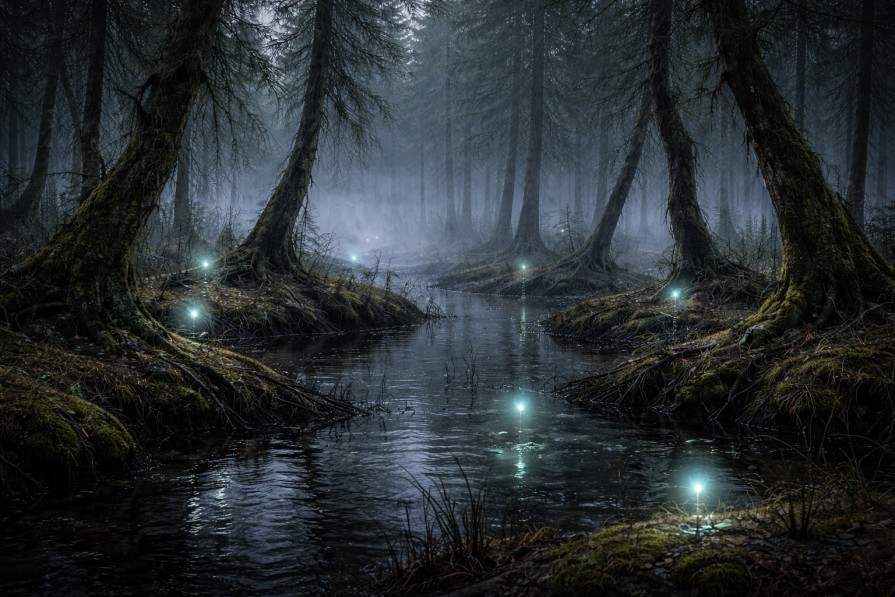
The Mistwoods (Lowland, boggy forest)
Core Identity
The Mistwoods are low-lying forest basins where water, shadow, and lingering light coexist. They are neither open marsh nor dry woodland, but a sodden forest hollow where the ground never fully dries and visibility is never complete.
This biome is shaped by standing water, drifting mist, and faint natural luminescence, giving it a quiet, unsettling presence without overt danger.
It feels watched — not by creatures, but by the land itself.
Landscape & Physical Form
The terrain sinks and collects.
- Shallow bogs, peat-soft ground, and waterlogged soil
- Pools of dark, still water between tree roots
- Narrow raised hummocks and root tangles serve as the only dry footing
- Slow seepage replaces flowing streams
Movement is careful and deliberate; the land resists haste rather than blocking passage outright.
Vegetation & Life
Vegetation is adapted to constant moisture and low oxygen soil.
- Slender, moisture-tolerant trees with shallow root systems
- Trunks often rise from pooled water or moss-covered bases
- Hanging mosses, lichen, and wet vines drape from branches
The forest floor is alive with:
- Thick moss
- Ferns
- Fungal growth
- Low, spongy plants
Bioluminescent growths appear naturally:
- Faintly glowing fungi on rotting wood
- Soft lights along moss-covered roots
- Hanging luminescent strands resembling will-o’-the-wisps, but anchored and stationary These lights are dim, cool-toned, and irregular — more like decay-glow than magic.
Light, Color & Atmosphere
Light is layered and distorted.
- Daylight is muted by canopy and mist
- Fog hangs low, especially near the ground
- Bioluminescent glow adds faint points of blue-green or pale teal light
Color palette:
- Deep, wet greens
- Cool greys
- Dark browns and black water
- Subtle cyan or blue-green highlights from natural glow
The air is damp, cool, and heavy, muffling sound and depth perception.
Human Relationship
Humans treat the Mistwoods with caution and respect.
- Settlements avoid the Mistwoods entirely
- Paths are raised on logs or follow known dry hummocks
- Locals know which lights mark safe ground and which do not
- Outsiders often mistake the glow for guidance — and step into water instead.
The forest is not malevolent, but it does not correct mistakes.
Emotional Impression
The dominant emotional tone is quiet eeriness.
- Uneasy
- Intimate
- Hypnotic
- Dampened
The Mistwoods feel like a place where sound fades and attention narrows.
Narrative & Quest Hooks
Common story themes include:
- Following or deliberately not following lights
- Recovering items lost in shallow bog water
- Traversing the area without leaving the raised ground
- Waiting for fog or glow to thin before moving
Prompt
Style: Semi-realistic fantasy landscape illustration, grounded and naturalistic, with restrained fantasy elements and no overt magic.
A misty lowland forest bog, where stunted, irregular trees grow from waterlogged ground. The trees are shorter than typical forest trees, with slightly twisted, leaning trunks that bend and angle as they reach toward scarce light. Their growth is uneven and stressed, shaped by constant moisture, poor soil, and limited sunlight.
Bark is dark and rough, partially covered in moss and lichen, especially near the base where trunks rise from shallow pools of peat-dark water. Exposed roots grip mud and submerged soil, spreading outward rather than downward.
The landscape is broken by reeds, moss-covered hummocks, spongy ground, dark still pools, and narrow, slow-moving channels. There are no clear paths — only uncertain footing between water and root.
Low fog hangs between the trees and close to the ground, softening edges and dissolving straight lines. Visibility is limited, and the forest appears warped and uneven even at a distance.
Faint will-o’-the-wisp lights appear sparingly throughout the Mistwoods — small, cool blue-green glows that hover just above the water or drift slowly between roots and low branches. They are dim, irregular, and widely spaced, unattached to any visible source, suggesting quiet presence rather than spectacle.
The lights do not illuminate the forest; they merely punctuate the mist, making depth and distance harder to judge.
Overall light is diffuse and grey-blue, with muted greens, wet browns, and black water dominating the palette. There are no sharp highlights or strong shadows.
The atmosphere feels quiet, damp, and uncertain — a place where growth is slow, movement is cautious, and attention matters more than speed.
No dramatic lighting, no bright colors, no creatures, and no overt magical effects.