The Sunscar Savanna
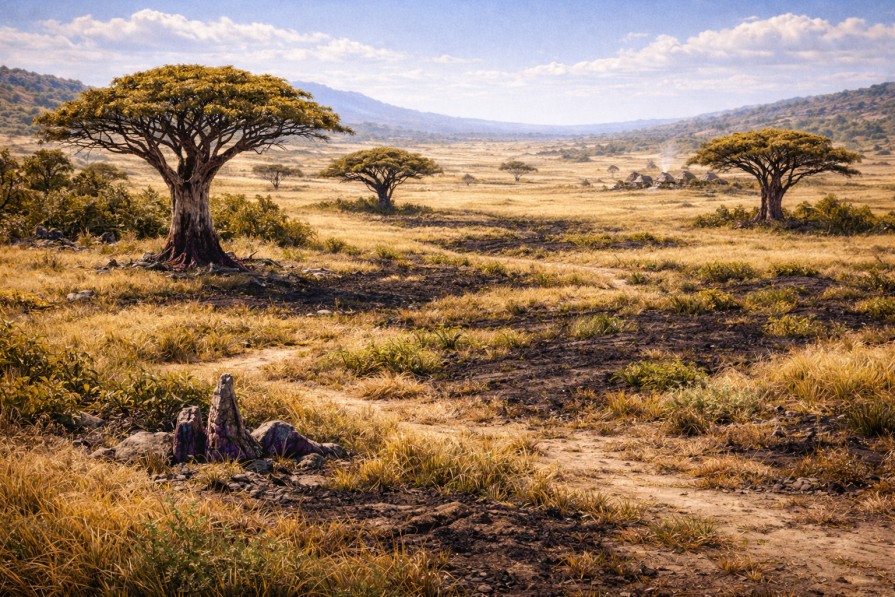
The Sunscar Savanna
Core Identity
The Sunscar Savannas are lands shaped by intense sunlight, seasonal drought, and recurring stress. They are not barren, but they are never comfortable. Life here persists through adaptation, timing, and recovery rather than abundance.
This biome represents resilience under pressure — a place where the land bears visible marks of survival.
Landscape & Physical Form
The terrain is broad and sun-exposed.
- Open plains with scattered rises and shallow basins
- Hard, sun-baked soil interspersed with softer seasonal ground
- Shallow waterholes that appear and vanish with the rains
- Dry channels that briefly carry water during storms
The land feels stretched and weathered, shaped by cycles rather than continuity.
Vegetation & Life
Vegetation is adapted to heat and scarcity.
- Tall, coarse grasses that dry and return
- Scattered, widely spaced trees with thick bark and deep roots
- Sparse shrubs and fire-tolerant plants
Growth is uneven:
- Lush after rains
- Brittle and sparse during drought
The land visibly recovers, but never fully resets.
Light, Color & Atmosphere
Light is harsh and dominant.
- Strong, direct sunlight for most of the day
- Heat shimmer near the ground
- Limited shade outside tree canopies
Color palette:
- Sun-bleached golds
- Dusty browns
- Pale greens
- Dark, heat-darkened tree bark
The air feels hot, dry, and heavy with stillness.
Human Relationship
Humans live with the Sunscar Savannas, not on top of them.
- Settlements are seasonal or mobile
- Water sources are closely guarded
- Knowledge of fire, rain, and timing is essential
People here respect:
- recovery periods
- overuse consequences
- the limits of endurance
Mistakes are slow to punish, but hard to undo.
Emotional Impression
The dominant emotional tone is strained resilience.
- Exposed
- Enduring
- Patient
- Weathered
The Sunscar Savannas feel survivable — but only with care.
Narrative & Quest Hooks
Common story themes include:
- Managing scarce water or grazing
- Timing travel around heat and storms
- Protecting recovery zones after fire or drought
- Deciding when to move on
Prompt
Style: Semi-realistic fantasy landscape illustration, grounded and naturalistic, with restrained fantasy elements and no overt magic.
A wide savanna landscape in a fantasy world, viewed from a slightly elevated perspective under strong, sun-bleached light.
Tall golden grasses stretch across open plains, broken by areas of dry, cracked earth and occasional shallow waterholes reflecting the bright sky. The land feels expansive and warm, shaped more by heat than by wind.
Scattered across the savanna stand sun-hardened trees with thick, plated bark in deep mahogany and dark purple tones, their trunks heavily weathered and fire-resistant. The bark appears cracked, layered, and heat-darkened, with subtle color variation where sunlight and age have marked the wood.
The tree canopies are uneven and asymmetrical, shaped by intense sunlight, drought, and recurring seasonal fires rather than uniform growth.
Around the bases of trees and in irregular patches across the land, grasses grow in uneven regrowth zones — some darker and sparse, others fresher and greener — forming a natural, organic mosaic of recovery rather than linear marks or paths.
Human presence is minimal and distant: small seasonal shelters barely visible on the horizon, low stone markers near water sources, and no roads, fences, or clear tracks cutting through the landscape.
The sky is wide and bright with high clouds, and the sunlight is intense but natural, casting sharp shadows that emphasize texture in bark, grass, and soil rather than direction or movement.
Colors are warm and distinctive: golden grasses, pale green regrowth, dusty browns, and the deep mahogany-to-purple bark tones that give the region its unique identity.
The atmosphere feels resilient and seasoned — a land shaped by heat, fire, and recovery, where survival depends on adaptation rather than abundance.
No glowing elements, no dramatic storms, no visible roads or tracks, no text.