The Broad Ranchlands
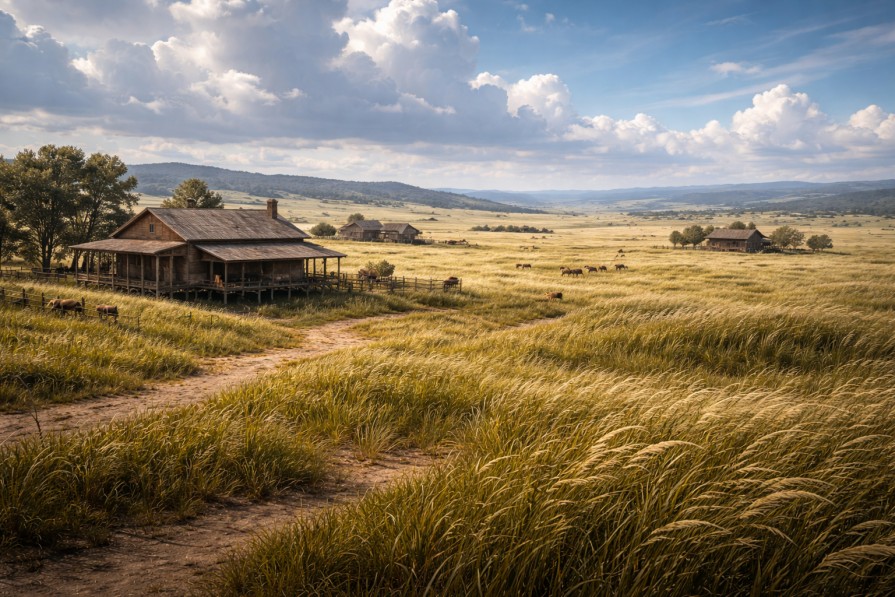
The Broad Ranchlands
Core Identity
The Broad Ranchlands are vast inhabited grasslands defined by scale, distance, and use rather than care. They are open lands shaped by grazing, wind, and movement, where human presence is sparse and practical.
This biome represents utility over intimacy.
Landscape & Physical Form
The terrain is wide and open.
- Mostly flat with subtle rises and shallow undulations
- Long sightlines and distant horizons
- Few natural landmarks
The land feels expansive and exposed rather than enclosed.
Vegetation & Life
Grass dominates everything.
- Mixed-height grass grows unevenly across the land
- Shorter grass near buildings and tracks
- Taller grass farther away, moving in wind-driven waves
Vegetation obscures detail rather than revealing it.
Livestock roam in loose groups rather than contained herds.
Light, Color & Atmosphere
Light is broad and unbroken.
- Strong sunlight under wide skies
- Large cloud shadows drift across the land
- Wind is constant and visible
Color palette:
- Sun-faded greens and pale golds
- Dry earth browns
- Open sky blues
The atmosphere feels spacious, dry, and restless.
Human Relationship
Humans inhabit the Broad Ranchlands lightly and pragmatically.
- Wooden ranch buildings raised slightly on stilts or posts
- Structures are widely spaced and isolated
- Few permanent boundaries
Settlements feel temporary even when long-standing.
Movement & Use
Movement is oriented toward distance.
- Dirt tracks stretch far between structures
- Paths follow practical routes, not aesthetic ones
- Travel is measured in time, not landmarks
The land resists enclosure and encourages motion.
Emotional Impression
The dominant emotional tone is lonely resilience.
- Open
- Honest
- Exposed
- Enduring
The Broad Ranchlands feel larger than those who work them.
Prompt
Style: Semi-realistic fantasy landscape illustration, grounded and naturalistic, with restrained fantasy elements and no overt magic.
A wide, open ranchland stretching toward distant horizons beneath a vast sky. The land is mostly flat to gently rolling, covered in tall, wind-swept grasses that move in broad, uneven waves. There are no hedges or stone walls — the terrain feels continuous and open, shaped by grazing and weather rather than division.
Scattered across the landscape are wooden ranch buildings raised slightly on low stilts or posts, simple and functional in design. The structures are widely spaced, connected by dirt tracks rather than roads, and oriented to face prevailing winds.
Grass height varies across the ranchlands. Around buildings, tracks, and frequently used areas, the grass is shorter and trampled, revealing the wooden stilts beneath raised structures and patches of bare earth. Beyond these zones, the grass grows much taller — long, narrow blades rising unevenly and bending under constant wind. In these areas, the grass moves in slow, rolling waves, briefly revealing pressed paths or grazing trails before closing again.
Livestock such as cattle or horses graze in loose groups, appearing small against the scale of the land. Fences, where present, are minimal and temporary, marking only immediate areas near buildings.
The light is strong and expansive, with large cloud shadows drifting slowly across the ground. Dust hangs faintly in the air near tracks, and the wind is always present.
The color palette is warm and open: sun-faded greens, pale gold grasses, soft browns of earth and wood, and a wide blue sky.
The atmosphere feels spacious, resilient, and lightly settled — a land defined by distance, movement, and practicality rather than enclosure.
No dense vegetation, no hedgerows, no decorative elements, and no magical effects.