The Patchwork Fields
The Patchwork Fields
Core Identity
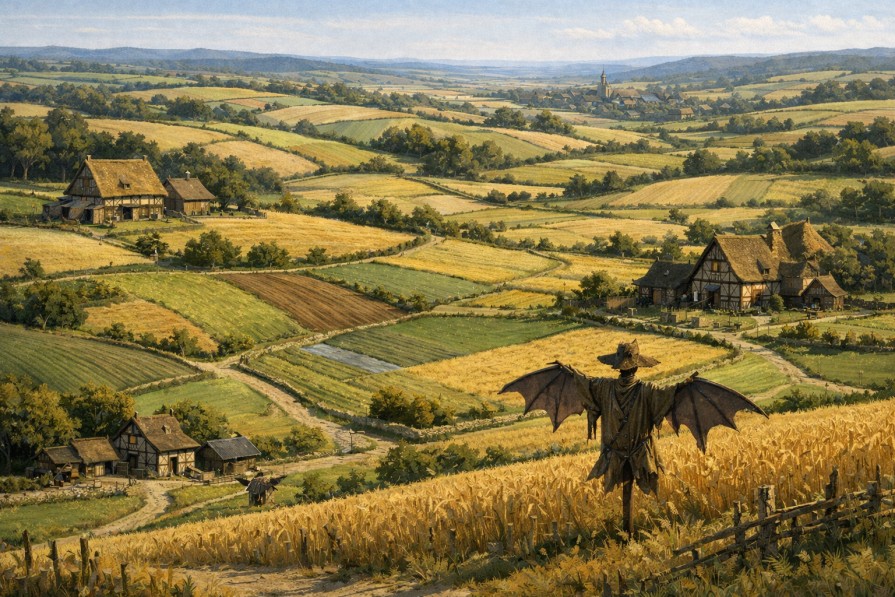
The Patchwork Fields are landscapes shaped by long-term human care rather than domination. They are agricultural lands divided, tended, repaired, and reused over generations, forming a visible record of human decision-making layered onto the natural world.
This biome represents stewardship and continuity — land that feeds people because people understand it.
Landscape & Physical Form
The terrain is gently varied and deliberately structured.
- Irregular fields stitched together like fabric
- Low hedgerows, stone walls, ditches, and paths marking boundaries
- Shallow slopes and valleys adapted rather than flattened
- Small streams diverted into irrigation channels
The land feels ordered, but never perfectly symmetrical.
Vegetation & Life
Vegetation is a mosaic of use.
- Cultivated crops in different stages of growth
- Pasture grasses and grazing land
- Fallow fields returning nutrients to the soil
- Hedgerows and field margins supporting wild plants
Trees appear as:
- Orchard rows
- Boundary markers
- Windbreaks
Life here is managed, but not erased.
Light, Color & Atmosphere
Light is open and seasonal.
- Broad sunlight across fields
- Long shadows cast by hedges and walls
- Clear visibility across multiple plots
Color palette:
- Golds, greens, and browns in shifting combinations
- Dark stone and earth tones in boundaries
- Seasonal variation is highly visible
The atmosphere feels productive, patient, and grounded.
Human Relationship
Humans are inseparable from the Patchwork Fields.
- Farmsteads, barns, and mills are scattered throughout
- Paths and tracks connect fields to villages and markets
- Knowledge is inherited: when to plant, rotate, rest, and harvest
Mistakes matter here — but so does repair.
The land responds to care.
Emotional Impression
The dominant emotional tone is reassurance and diligence.
- Familiar
- Purposeful
- Calm
- Earned
The Patchwork Fields feel like a place where effort has meaning.
Narrative & Quest Hooks
Common story themes include:
- Seasonal labor and preparation
- Boundary disputes or land inheritance
- Protecting harvests or water sources
- Tracing the history of a particular field or farm
Prompt
Style: Semi-realistic fantasy landscape illustration, grounded and naturalistic, with restrained fantasy elements and no overt magic.
A wide landscape of patchwork agricultural fields in a fantasy world, viewed from a gentle elevated perspective.
The land is divided into many irregular plots of different shapes and sizes, stitched together like a quilt. Each field shows subtle variation in color and texture: golden grain fields, muted green pasture, freshly tilled brown soil, and pale fallow land.
Narrow hedgerows, low stone walls, shallow irrigation channels, and winding dirt paths form the boundaries between fields.
Scattered among the fields are small medieval timber-framed farmhouses and barns, built from dark wooden beams with pale infill walls and steep thatched roofs. The buildings feel practical, weathered, and lived-in, with fenced yards and small outbuildings.
In a few fields stand simple scarecrows made from wood and cloth, some with subtle wing-like shapes or fabric extensions that suggest dragon wings rather than literal dragons. These details are understated and easy to miss.
When viewed as a whole, the arrangement of fields forms faint repeating curves and alignments, hinting at long-held farming traditions rather than overt magic.
Lighting is warm late-afternoon sunlight with soft shadows. The color palette is earthy and natural: ochres, warm browns, soft greens, and faded yellows.
The overall style is grounded fantasy realism — believable, human-scaled, and pastoral — with no glowing elements, no modern machinery, and no text.