The Seven Prasats
Description
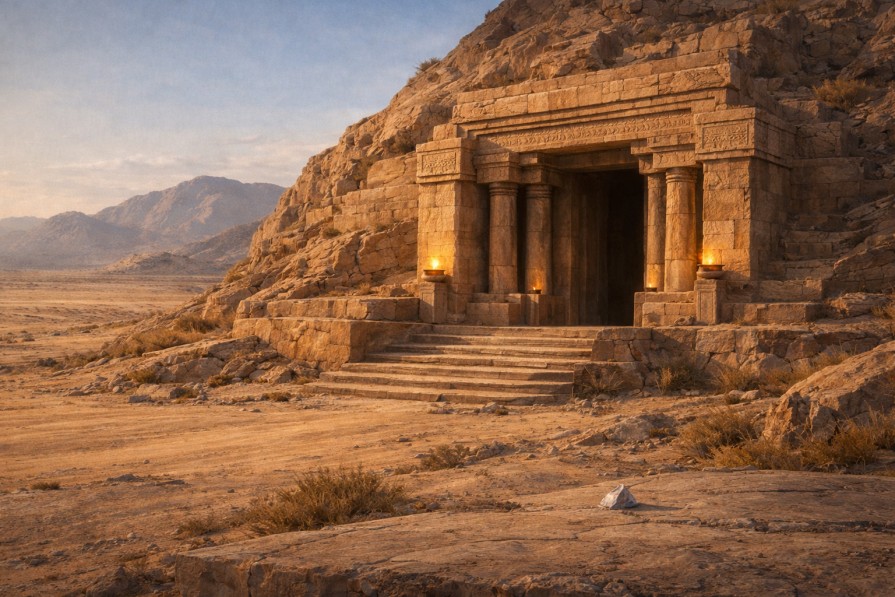
The Seven Prasats are a chain of stone sanctuaries carved high into the foothills of the Aleron range, overlooking open desert and savanna below. Each Prasat stands apart from the others, separated by distance, elevation, and approach, yet bound together by shared purpose and alignment.
They are not hidden. Their silhouettes are visible from far below, set into rock faces and ridgelines where approach is slow and exposed. Wind, heat, and altitude shape every path leading upward.
To outsiders, they are often described as temples.
To the Kharu, they are places of discipline.
Form & Setting
Each Prasat is built directly into stone.
Walls, floors, and chambers emerge from the mountain rather than standing upon it. Architecture is severe and deliberate: narrow approaches, open courtyards, long sightlines, and spaces designed for stillness rather than congregation.
No single Prasat is identical. Orientation, elevation, and internal layout vary, reflecting different modes of practice. What unites them is restraint — nothing decorative without purpose, nothing enclosed without reason.
There are no walls around the Prasats. The mountain itself is the boundary.
Purpose
The Seven Prasats are dedicated to the cultivation of martial virtue.
Each Prasat embodies one of seven virtues through disciplined practice rather than doctrine: Vigilance, Restraint, Endurance, Precision, Resolve, Loyalty, and Silence. These are not ideals to be admired from afar, but capacities refined through exposure, repetition, and controlled difficulty.
The Prasats are not places of worship in the conventional sense. No gods are invoked, and no offerings are made for favor. Instead, they serve as sites of practice, meditation, and refinement — places where attention, judgment, and self-command are tested under conditions that allow no distraction.
Every seven years, the Kharu undertake a pilgrimage to the Prasats. Participants divest themselves of all personal wealth before the ascent, carrying instead objects chosen solely for intention and form. These are borne upward through heat, wind, and exposure, and left behind within the sanctuaries as part of the practice itself.
Nothing carried to a Prasat is brought back down.
Wealth & Vigilance
The Prasats are known to contain objects of great material value.
This is not concealed.
For generations, raiders and opportunists have attempted to breach the Prasats, drawn by stories of unguarded riches. Tales of successful raids circulate widely, but none have ever been confirmed. No artifact has been produced. No breach has been recorded.
Defense of the Prasats relies on vigilance rather than fortification. The open approaches, exposed ascents, and long sightlines favor those who know the land. Violence, when required, is swift and contained.
The Prasats endure because attention does.
Relationship to the Kharu
The Seven Prasats are inseparable from Kharu tradition.
They are the physical anchors of the Kharu belief system, each Prasat embodying one of seven martial virtues through practice rather than doctrine. These virtues are not taught as ideals, but cultivated through discipline, exposure, and restraint. To be Kharu is to understand the Prasats not as monuments, but as places where character is refined and tested.
The Kharu do not speak of owning the Prasats. They guard them because the practices they represent must endure. Defense of the Prasats is considered a responsibility rather than a claim — vigilance in service of continuity, not authority.
Travelers of other clans may approach the Prasats, but such journeys are rare. Entry into Prasat practice requires full divestment of personal wealth before ascent, without exception. What is carried upward may not be reclaimed. This requirement alone deters most, and those who undertake it do so with intent rather than curiosity.
As a result, the Prasats are not destinations, pilgrimage attractions, or sites of spectacle. They are places of commitment. The Kharu act as their stewards not to preserve secrecy, but to ensure that the virtues they embody are not diluted, commodified, or misunderstood.
Those who complete a Prasat ascent — Kharu or otherwise — rarely speak of it. What matters is not what was surrendered, but what was proven capable of remaining.
Emotional Impression
The Seven Prasats inspire a sense of exposed clarity.
- Severe
- Disciplined
- Unyielding
- Quietly formidable
They are landmarks of restraint rather than power — places that dare others to misunderstand them.
Quests
No quests currently recorded.
Map
Find the Seven Prasats on a Map
Prompt
Style: Semi-realistic fantasy landmark illustration, grounded and architectural, with restrained fantasy elements and no overt magic.
A series of stone sanctuaries carved into high mountain foothills. Each structure emerges from rock rather than standing apart from it. Approaches are narrow and exposed, with long sightlines across desert and savanna below.
Architecture is austere and deliberate: clean stone surfaces, sharp edges, open courtyards, and minimal ornamentation. No banners, no symbols, no glowing elements.
Light is strong and clear, emphasizing form, elevation, and distance. The atmosphere should feel disciplined, exposed, and resolute — a place shaped by practice, restraint, and vigilance rather than devotion or spectacle.