Kareth Caverns
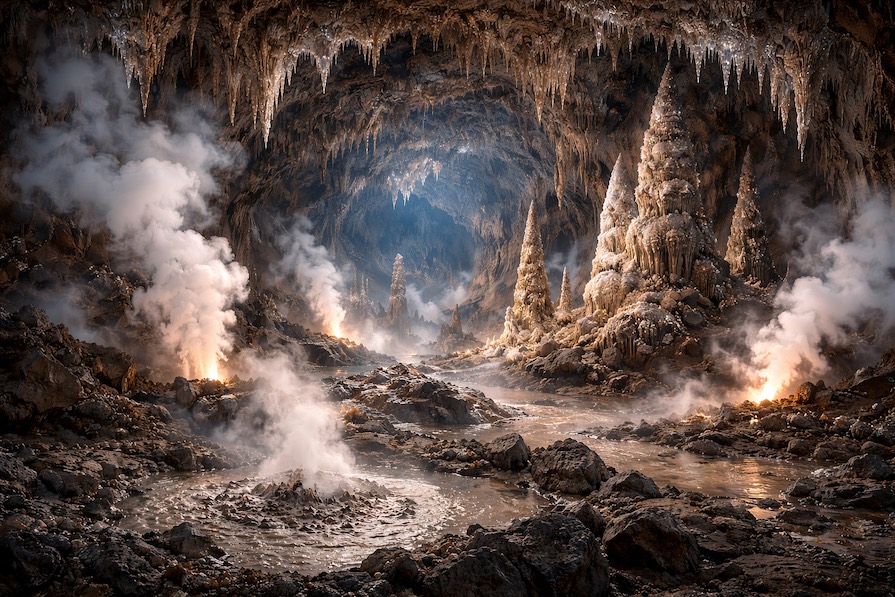
The Kareth Caverns are an extensive volcanic cave system beneath the lower flanks of Mount Kareth. Though often assumed to be a mining complex, their primary role is soil nourishment, not metal extraction.
The caverns supply the mineral fertilizers that sustain Belthari agriculture across the riverlands of Wendmor. Without this steady input, Belthari fields would lose structure and yield over time, regardless of labor or irrigation.
Kikala life within the caverns is therefore oriented toward continuity: maintaining the conditions that allow soil aboveground to remain productive for generations.
Geological Formation
The caverns formed through repeated basaltic eruptions followed by long cooling periods. As lava drained away, hardened shells collapsed and fractured, creating interlinked tunnels, pressure chambers, and mineral seams.
Over centuries, geothermal heat and groundwater interaction altered volcanic ash and basalt into mineral forms that are chemically stable and agriculturally useful. The caverns continue to evolve slowly, with minor collapses and new exposures shaping Kikala work patterns.
Fertilizer-Bearing Materials
The value of Kareth Caverns lies in materials suited for soil renewal rather than ornament or weaponry.
Volcanic Ash Concentrates
- Finely altered ash rich in potassium, phosphorus, and trace minerals
- Improves long-term soil fertility and moisture retention
- Applied thinly over wide field areas
Sulfur and Sulfate Deposits
- Collected near warm vented chambers
- Used to correct alkaline soils and suppress fungal growth
- Essential during Belthari crop rotation recovery cycles
Basalt-Derived Calcium Dust
- Produced during tunnel shaping and maintenance
- Stabilizes soil acidity and strengthens root development
- Often introduced through irrigation systems
Mineral Silt Compounds
- Settled and filtered from underground wash channels
- Processed into dense pellets for controlled application
- Designed to release nutrients slowly over multiple seasons
The Kikala classify fertilizers by field response, not abstract composition: how they change soil behavior, water movement, and root depth over time.
Mining as Agricultural Engineering
Extraction within Kareth Caverns is structured around predictable renewal, not maximum yield.
Key practices include:
- Grinding and abrasion rather than blasting
- Long maturation periods for ash and mineral blends
- Strict limits on sulfur exposure
- Output schedules aligned with Belthari planting and flooding cycles
Certain seams are deliberately left untouched for decades to allow chemical stabilization. Kikala records often note when not to mine, rather than where to dig.
Many productive Belthari harvest years trace directly to Kikala restraint in earlier seasons.
Belthari–Kikala Collaboration
Kareth Caverns operate as part of a shared agricultural system.
- Belthari councils provide soil feedback, yield data, and irrigation behavior
- Kikala adjust mineral blends and extraction depth accordingly
- Fertilizer output is allocated by agreement rather than sold openly
Compensation takes the form of grain guarantees, labor exchange, transport support, and long-term security commitments. Coin plays a minor role.
This collaboration allows Belthari lands to sustain high yields without soil exhaustion, even under population pressure.
Secondary Outputs
While fertilizer is the core purpose, Kareth Caverns produce secondary materials:
Obsidian
- Harvested from brittle cooling lenses
- Used for precision tools and fine cutting edges
- Extraction is limited due to structural risk
Rare Crystalline Formations
- Occur in gas pockets and pressure fractures
- Too fragile for mass trade
- Often retained for measurement, signaling, or ceremonial use
Basalt Construction Stone
- Exported in shaped blocks
- Used in mills, granaries, canals, and irrigation works
These activities are permitted only insofar as they do not disrupt fertilizer production.
Processing and Transport
All fertilizer materials are processed underground to prevent contamination.
Methods include:
- Dry grinding in low-humidity chambers
- Pelletization using mineral binders
- Cooling and aging in stable vaults
Transport follows established routes into the Belthari riverlands, primarily by barge. Shipments are intentionally heavy and slow-moving to prevent misuse or over-application.
Environmental Balance
The caverns are managed as a controlled system:
- Heat vented through abandoned shafts
- Water runoff filtered through silt traps
- Collapse zones mapped and left undisturbed
Kikala doctrine holds that surface soil collapse is worse than tunnel collapse. Their practices reflect this priority.
Cultural Consequences
Life in Kareth Caverns has shaped Kikala values:
- Measurement over haste
- Maintenance over expansion
- Collaboration over ownership
Children learn to test mineral blends before learning any craft. Errors are remembered not as broken tunnels, but as failed harvests aboveground.
What is taken below determines what grows above.
Prompt
Semi-realistic fantasy cave environment inspired by vast limestone caverns like Carlsbad Caverns, but heightened with dramatic scale and atmosphere.
A wide, landscape-format view of an enormous underground chamber with towering stalactites and stalagmites, some forming cathedral-like columns. Rock surfaces are richly textured, layered, and mineral-heavy, with subtle crystalline sparkle catching the light.
Signs of volcanic activity are present but restrained: multiple steam vents (fumaroles) venting white and grey steam from cracks in the cave floor, and shallow bubbling mud pools with thick, mineral-rich slurry gently popping and steaming. No flowing lava or open magma — heat is implied through steam, haze, and warm highlights only.
The cave floor is uneven and rocky, partially wet with reflective mineral water and mud. Steam drifts through the chamber, creating depth and atmospheric perspective.
Lighting is dramatic and cinematic: cool ambient blues and greys from reflected mineral light mixed with warm, amber highlights from geothermal heat below. Strong contrast, volumetric lighting, soft mist, and shafts of light filtering from unseen openings above.
Mood: awe-inspiring, ancient, powerful, and alive — a place of deep geology and latent energy rather than active destruction.
Style: highly detailed, grounded fantasy realism, naturalistic textures, no cartoon style, no characters, no modern elements, epic environmental concept art quality.