The Marshfolds
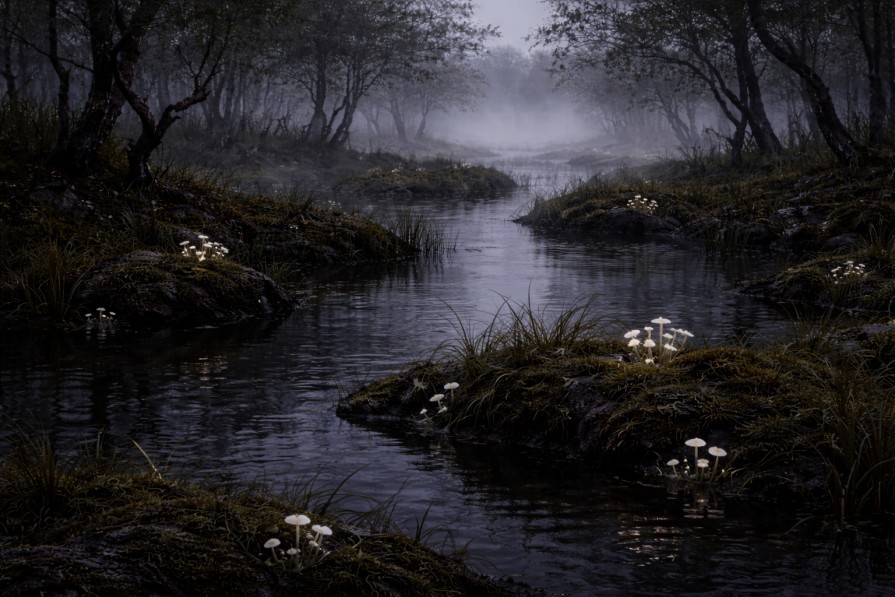
The Marshfolds
Core Identity
The Marshfolds are landscapes shaped by stillness, saturation, and accumulation. They are inland wetlands where water lingers, spreads, and folds the land inward rather than flowing through it.
This biome represents slow change — not decay, not danger, but persistence through saturation.
Nothing here moves quickly, including time.
Landscape & Physical Form
The terrain is flat, layered, and difficult to read.
- Broad marshes broken by shallow rises and sunken pools
- Soft ground that shifts underfoot
- Meandering channels that double back on themselves
- Raised patches of sedge, peat, and grasses forming natural islands
The land feels folded and compressed, with few clear lines or edges.
Vegetation & Life
Vegetation is dense, low, and water-loving.
- Tall reeds, sedge, and marsh grasses dominate
- Low shrubs and scattered scrub on firmer ground
- Very few trees, and those that exist are stunted and widely spaced
- Ghostcap mushrooms
Plant life grows in thick bands and mats, creating natural barriers and hidden pockets.
Life here is abundant but subtle — more heard than seen.
Light, Color & Atmosphere
Light is muted and diffused.
- Overcast skies are common
- Sunlight reflects off water in broken fragments
- Mist rises from warm marshes in cooler air
Color palette:
- Dull greens and olive tones
- Muddy browns
- Dark, reflective water
- Pale sky greys
The air feels damp, heavy, and still, carrying sound only short distances.
Human Relationship
Humans approach the Marshfolds with care and local knowledge.
- Settlements are rare and built on raised ground
- Travel follows known paths or raised causeways
- Getting lost is easy; getting unstuck is harder
The Marshfolds do not repel people — they slow them down.
Emotional Impression
The dominant emotional tone is oppressive calm.
- Heavy
- Quiet
- Enclosing
- Patient
The Marshfolds feel like a place where effort drains rather than resists.
Narrative & Quest Hooks
Common story themes include:
- Slow traversal under pressure
- Recovering items lost to water and mud
- Navigating paths that change subtly over time
- Waiting for water levels to shift
Ghostcap Mushrooms
Pale white to bone-colored fungi with thin stems and delicate, slightly translucent caps. In deep shade or heavy mist, their caps appear faintly luminous, not glowing but softly catching and diffusing ambient light.
Prompt
Style: Semi-realistic fantasy landscape illustration, grounded and naturalistic, with restrained fantasy elements and no overt magic.
A broad, low-lying marshland of shallow standing water and soft, muddy ground, where reeds, sedges, and rushes grow thickly across uneven terrain. Solid footing appears only as narrow ridges and moss-covered hummocks rising just above the water. Sparse, stunted trees with twisted trunks grow in isolated clusters, their roots submerged and their branches leaning outward.
The water is dark and reflective, obscuring its depth and blurring reflections of sky and vegetation. Subtle ripples, small bubbles, and shifting reflections suggest movement beneath the surface without revealing its source. Mist hangs low across the marsh, especially in the mid-distance, softening outlines and collapsing depth so that landmarks appear closer than they are.
Growing sparingly at the bases of reeds, half-submerged roots, and along the edges of mossy hummocks are small clusters of Ghostcap mushrooms — pale white to bone-colored fungi with thin stems and delicate, slightly translucent caps. In deep shade or heavy mist, their caps appear faintly luminous, not glowing but softly catching and diffusing ambient light. These mushrooms are rare, low to the ground, and irregularly spaced, never forming lines or clusters large enough to guide movement.
Colors remain muted and cool — grey-greens, brown-greens, dark peat tones, and silvery highlights where light touches the water — with the Ghostcaps providing only subtle points of pale contrast rather than brightness. Light is diffuse and flat, with few strong shadows.
The atmosphere feels slow, saturated, and quietly remembering, as if the marsh has absorbed what has passed through it and does not readily give it back.
There are no visible spirits, figures, faces, or overt magical effects — only natural ambiguity, concealment, and the sense of a place shaped by water, time, and accumulation.