Plants, Trees and Flowers
The Heliovar Bloom
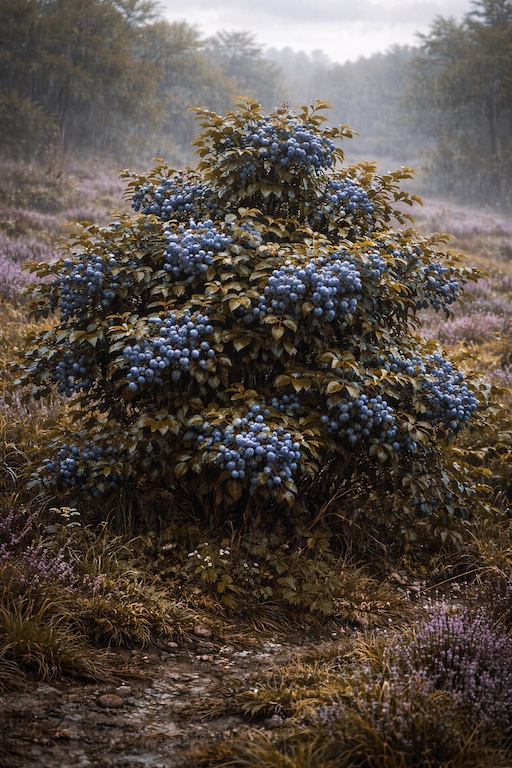
Lazuliberries
Lazuliberries grow on low, dense bushes that thrive only in the cool, humid lowlands of Safira. The plants favor constant drizzle, waterlogged soil, and open ground, spreading in wide mats rather than growing tall. Their leaves are waxy and dark, shedding water easily, while clusters of pale blue berries develop close to the stem, protected from wind and exposure. Attempts to cultivate Lazuliberries outside Safira have consistently failed; without the region’s specific combination of moisture, temperature, and soil, the bushes weaken and stop fruiting.
The berries are not widely eaten by people, but they are the exclusive food source of the Kelmar. Kelmar grazing shapes the growth of Lazuliberry fields, keeping the bushes productive and preventing other plants from taking hold. This relationship binds animal, plant, and landscape into a single system: where Lazuliberries fail, Kelmar do not survive. As a result, Lazuliberries are not merely a crop, but the ecological foundation upon which Safira’s leather trade — and the lives built around it — depend.
The Heliovar Bloom
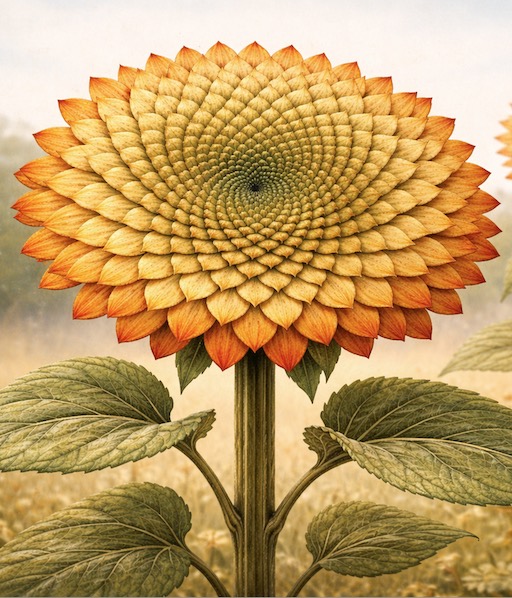
Heliovar Bloom
Similar to sunflower (Fibonacci) but grows in the Belthara region.
Color: Base tone:
- Muted gold → pale ochre across most of each scale
- Slight variation between neighboring scales (never uniform)
Tips (key addition):
- Each petal-scale ends in a soft amber / near-orange tip
The color shift is:
- Subtle
- Dry and sun-warmed, not glossy
- More pronounced on outer scales, gentler toward the center
Spiral core:
- denser, darker green
Stalks and leaves:
- deep agricultural green (matching Belthara’s people)
Center Spiral:
- Dense overlapping scales
- Colors deepen into:
- Olive green
- Shadowed gold
- Amber tips become smaller and less saturated toward the core This keeps the spiral visually anchored.
Fibonacci Structure: Instead of seeds
- The bloom face is composed of overlapping petal-scales
- Each scale is:
- Rounded at the outer edge
- Slightly raised, creating shallow relief
- The scales form two interlocking spiral directions
- The spiral count clearly follows Fibonacci progression
Cultural Use:
- The bloom is harvested after flowering
- Petal-scales are dried and pressed
- The spiral pattern becomes a traditional Beltharan weave motif
Notes:
- Someone recognizes it as order repeating itself
- Beltharan farmers treat it as obvious — “It’s how things grow”
Pattern: The Heliovar Field Weave:
Motif
- A simplified Heliovar spiral
- Based on the overlapping petal-scale shape
- Central spiral clearly visible, but softened
- Repeat logic
- Motifs repeat in a loose grid or staggered rows
- Slight rotation variance between repeats
- Generous negative space between motifs
This mirrors:
- Fields with paths between them
- Crops planted in rows, not packed tightly
- Growth with breathing room