The Glacial Expanse
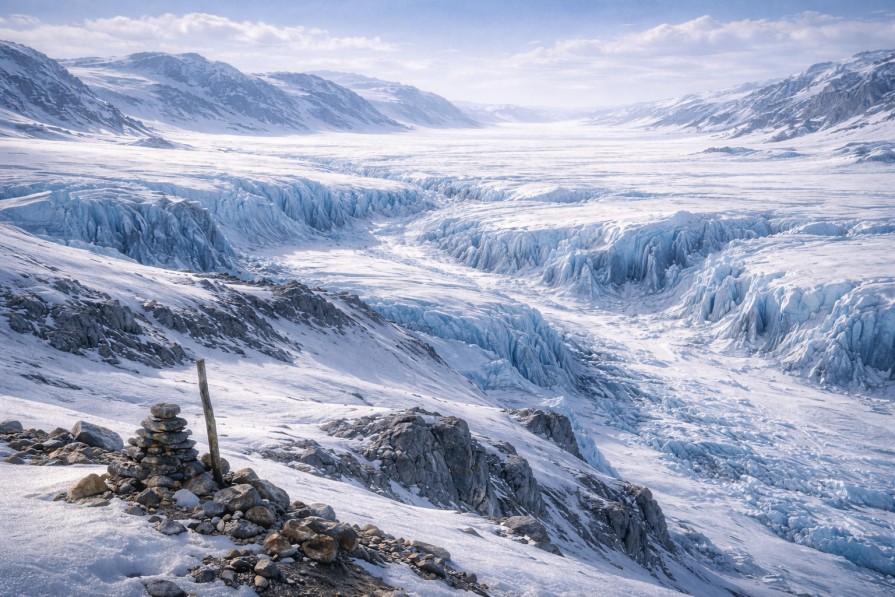
The Glacial Expanse
Core Identity
The Glacial Expanse is a land defined by absolute limits. It is not shaped for habitation, negotiation, or persistence — only by pressure, time, and movement.
This biome represents deep time and inevitability, where human intention becomes irrelevant.
Cold here is not a condition. It is the terrain itself.
Landscape & Physical Form
The land is dominated entirely by ice.
- Vast glaciers and ice sheets
- Deep crevasses and pressure ridges
- Polished stone exposed where ice retreats
- No stable ground
The landscape moves slowly but inexorably, reshaping itself over centuries.
Vegetation & Life
There is effectively no plant life.
- No soil
- No sustained growth
- Only ice, stone, and snow
Any traces of life are fleeting and peripheral, appearing only at the very edges.
Light, Color & Atmosphere
Light is diffuse and cold.
- Pale skies
- Soft blue-toned shadows
- Strong reflection off ice surfaces
Color palette:
- Whites
- Pale greys
- Icy blues
- Deep blue ice
The air feels immense, silent, and empty.
Human Relationship
Humans do not belong here.
- No permanent settlements
- Only brief incursions or markers
- Travel is rare and dangerous
Any human trace feels temporary and insignificant.
The Glacial Expanse does not respond to effort.
Emotional Impression
The dominant emotional tone is awe and finality.
- Vast
- Silent
- Unyielding
- Humbling
The Glacial Expanse does not threaten — it simply exists.
Narrative & Quest Hooks
Common story themes include:
- Reaching the edge of the known world
- Recovering something lost to ice
- Witnessing remnants of deep history
- Turning back
Prompt
Style: Semi-realistic fantasy landscape illustration, grounded and naturalistic, with restrained fantasy elements and no overt magic.
A vast glacial landscape in a fantasy world, viewed from a high, distant perspective.
Immense ice sheets and slow-moving glaciers dominate the land, their surfaces marked by pressure ridges, deep crevasses, and layered blue ice. Snow lies thick across the terrain, sculpted into smooth drifts and sharp edges by relentless wind.
The ice shows subtle banding and depth, hinting at centuries of accumulation and movement rather than uniform frozen ground. Occasional dark stone outcrops emerge from the ice, polished smooth by pressure and time.
There is little sign of life. Any human presence is minimal and distant — perhaps a half-buried marker or a broken pole swallowed by the glacier, emphasizing scale and abandonment.
The sky is pale and cold, with thin clouds diffusing the light so that shadows are soft and blue-toned rather than harsh.
Colors are restrained and frigid: whites, pale grays, icy blues, deep blue ice, and muted stone.
The atmosphere feels immense, silent, and ancient — a place shaped by pressure and time rather than intention.
No glowing elements, no dramatic storms, no creatures, no text.