Breakshore Cliffs
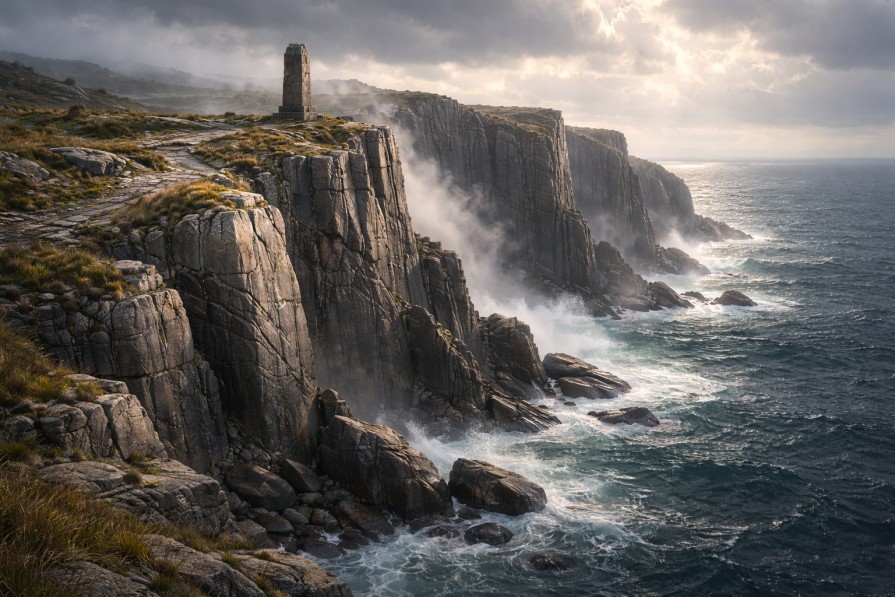
The Breakshore Cliffs
Core Identity
The Breakshore Cliffs are landscapes defined by collision — land meeting sea with no negotiation. They are steep, exposed coastlines where rock resists erosion only partially, and the sea never stops trying.
This biome represents final boundaries: the last solid ground before open water.
Landscape & Physical Form
The terrain is vertical, fractured, and exposed.
- Sheer sea cliffs and broken escarpments
- Narrow ledges and wind-carved shelves
- Fallen rock piles at the base of cliffs
- Inaccessible coves and deep water close to shore
Movement is constrained by height and exposure rather than distance.
Vegetation & Life
Vegetation is sparse and tenacious.
- Salt-tolerant grasses and low shrubs clinging to cracks
- Wind-shaped bushes and occasional twisted trees on sheltered ledges
- Lichen and moss dominating exposed stone
Life here survives through anchoring, not growth.
Bird life (if present) nests on ledges rather than inhabiting the land itself.
Light, Color & Atmosphere
Light is stark and dramatic.
- Strong contrast between sunlit rock and deep shadow
- Frequent mist and sea spray softening edges
- Rapid weather shifts driven by open water
Color palette:
- Cold greys and dark stone
- Chalky whites and salt-streaked rock
- Deep blues and greens of open sea
The air is loud, sharp, and restless.
Human Relationship
Humans treat the Breakshore Cliffs with respect and distance.
- Watchtowers, lighthouses, or signal fires on high points
- Paths follow cliff tops, not edges
- Descents to the water are rare, steep, and dangerous
People come here to observe, not to settle.
Emotional Impression
The dominant emotional tone is exposure and finality.
- Isolated
- Wind-scoured
- Watchful
- Unforgiving
The Breakshore Cliffs feel like the edge of certainty.
Narrative & Quest Hooks
Common story themes include:
- Watching for ships or storms
- Reaching a dangerous lookout or signal point
- Recovering something lost to the sea
- Deciding whether to descend or turn back
Prompt
Style: Semi-realistic fantasy landscape illustration, grounded and naturalistic, with restrained fantasy elements and no overt magic.
A dramatic rocky coastline where sheer sea cliffs rise directly from a dark, restless ocean. The cliffs are tall, fractured, and weathered, their faces carved by centuries of wind and waves into sharp ledges, deep fissures, and vertical walls. Massive fallen stone blocks lie scattered at the base of the cliffs, partially submerged by the sea.
The rock formations have a subtle, unusual geometry — long, slightly curved strata and repeating natural patterns that feel ancient and deliberate without appearing artificial. In places, the stone layers bend or fold in ways that suggest immense age and pressure rather than construction.
Sparse, wind-beaten vegetation clings to cracks and narrow ledges: low salt grasses, lichen, and a few twisted shrubs shaped flat by constant wind. No trees grow near the cliff edge.
Far above the water, a narrow cliff-top path and a single ancient stone marker or watch pillar stand silhouetted against the sky — worn smooth, undecorated, and partially broken, suggesting long-forgotten use rather than active magic.
The sea below is deep blue-green, with white spray and mist rising where waves strike the rock. Sea fog drifts intermittently along the cliff face, softening edges and partially obscuring depth.
Light is stark and shifting: bright sun breaks through clouds to illuminate sections of rock while other areas fall into cool shadow.
The color palette is cold and restrained — slate greys, dark stone blues, chalky whites, muted greens, and deep ocean tones.
The atmosphere feels exposed, wind-scoured, and final — a place where land ends abruptly and the open sea begins.
No glowing elements, no visible creatures, no dramatic storms, and no overt magical effects.